On this page
- Are Crucible Passive Skill Trees Still Available in PoE 2026?
- How Do Crucible Passive Skill Trees Work?
- PoE Crucible Passives List by Weapon Type
- Types of Crucible Passive Skills
- Examples of Notable Crucible Passives
- How to Unlock a Crucible Passive Skill Tree
- How to Remove a Crucible Passive Skill
- How to Combine Crucible Passive Skill Trees
- Crucible Passive Trees on Unique Items
- Crucible Passives and Crafting Interactions
- How to Evaluate Crucible Weapons in Standard
- Crucible 3.21.0c Patch Changes
- PoE Crucible Passive Skill Tree FAQs
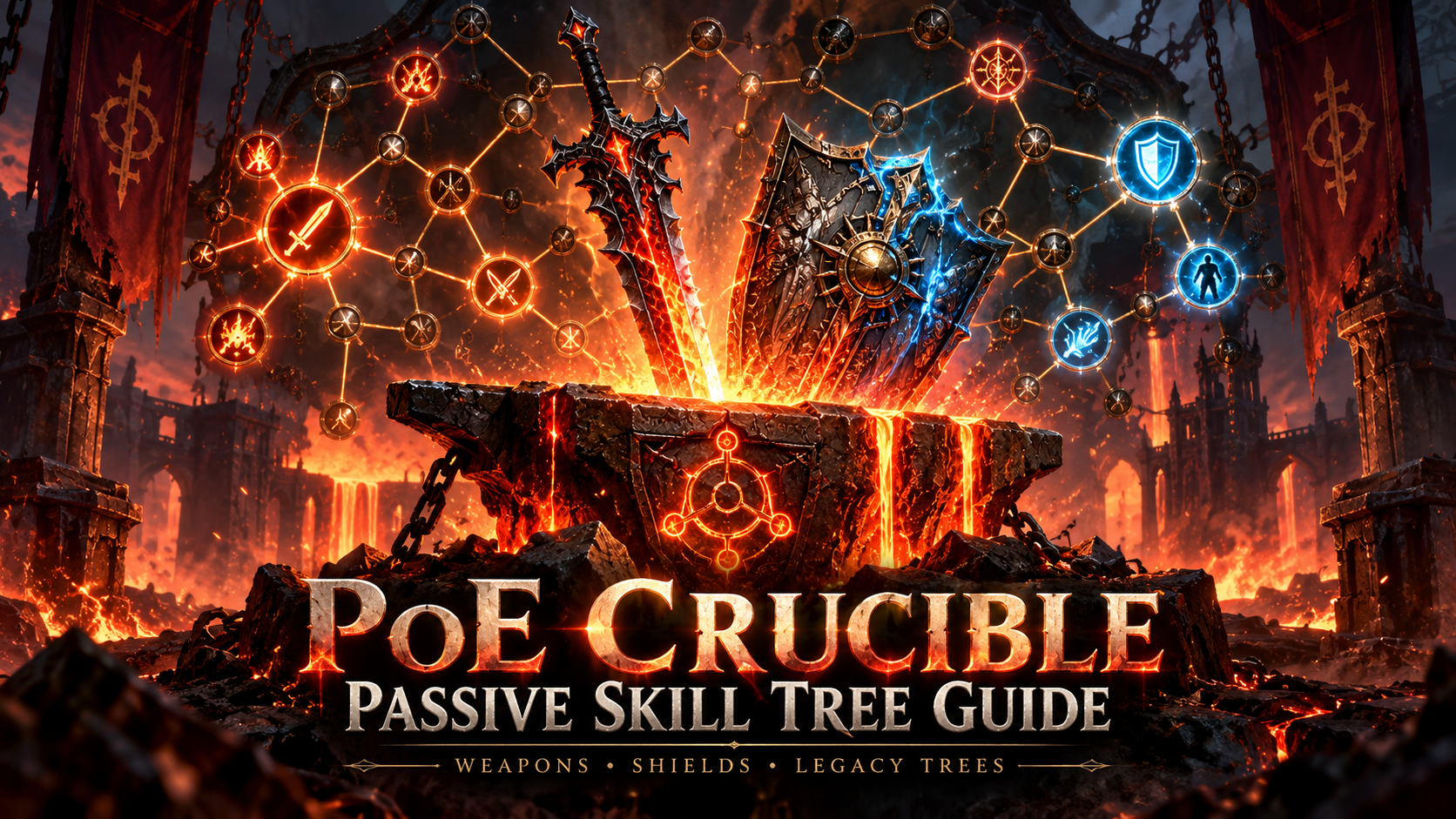
The Crucible Passive Skill Tree is a special item-enhancement system introduced in Path of Exile 3.21. It allows weapons and shields to have their own passive trees, granting additional damage, defensive bonuses, skill modifiers, and sometimes powerful effects that change how a build works.
Unlike the character’s regular passive skill tree, Crucible passives are attached directly to equipment. Each tree can contain up to five depths of passives, with different branches and modifiers determined by the item’s type and item level.
Are Crucible Passive Skill Trees Still Available in PoE 2026?
Yes, but only as legacy equipment in Standard. Crucible was introduced on April 7, 2023, and ended on August 15, 2023. Grinding Gear Games confirmed that the mechanic would not become part of the core game, but existing Crucible items would transfer to Standard.
As of October 2026:
- Existing weapons and shields with Crucible Passive Skill Trees remain available in Standard.
- Players cannot generate new Crucible trees through ordinary encounters in the current challenge league.
- Crucible Forges and the Forge of the Titans are no longer available through normal gameplay.
- Historical Crucible passives remain relevant when evaluating legacy equipment.
- The original Crucible crafting and tree-merging processes cannot be repeated through the retired league mechanic.
This guide explains both the historical Crucible system and how to understand existing Crucible items in Standard.
How Do Crucible Passive Skill Trees Work?
A Crucible Passive Skill Tree is a branching set of modifiers attached to a specific weapon or shield. During Crucible league, players unlocked these trees by completing Crucible Forge encounters and earning experience for their chosen items.
Each tree has several important characteristics:
| Feature | Description |
|---|---|
|
Maximum depth |
Up to 5 columns |
|
Minimum depth |
2 columns |
|
Passive allocation |
One passive per depth |
|
Tree generation |
Randomized within eligible modifier pools |
|
Item requirements |
Depends on item class and item level |
|
Weapon categories |
One-handed and two-handed weapons, including bows |
|
Defensive equipment |
Shields |
|
Unique items |
Required a special Forge of the Titans process |
|
Tree progression |
Earn Crucible experience and unlock connected nodes |
|
Tree merging |
Was performed in the Forge of the Titans |
The tree’s modifiers do not replace the item’s ordinary explicit or implicit modifiers. Instead, they provide an additional layer of item customization.
Not every passive is available on every weapon. Bows, wands, sceptres, claws, swords, shields, and other equipment categories have different modifier pools.
For example, a bow can generate bow-related bonuses, while a sceptre can generate spell-oriented bonuses that would not necessarily be available on a bow. Higher-item-level equipment can qualify for more powerful modifier tiers.
PoE Crucible Passives List by Weapon Type
Crucible passives are divided into different pools based on the equipment category. Offensive weapons generally have damage-oriented modifiers, while shields tend to emphasize defensive bonuses.
| Weapon Type | Common Crucible Passive Categories |
|---|---|
|
One-Handed Swords |
Physical damage, attack speed, critical strikes, melee skills |
|
Thrusting One-Handed Swords |
Critical strikes, physical damage, attack modifiers |
|
One-Handed Axes |
Physical damage, bleeding, attack bonuses |
|
One-Handed Maces |
Physical damage, elemental damage, melee modifiers |
|
Claws |
Attack speed, critical strikes, chaos damage, poison |
|
Daggers |
Critical strikes, poison, physical and elemental damage |
|
Rune Daggers |
Spell damage, critical strikes, elemental modifiers |
|
Wands |
Spell damage, elemental damage, critical strikes |
|
Sceptres |
Spell damage, elemental modifiers, skill-related bonuses |
|
Bows |
Projectile damage, attack speed, elemental damage, bow-specific skills |
|
Staves |
Spell modifiers, elemental damage, gem levels |
|
Warstaves |
Attack modifiers, physical damage, melee skills |
|
Two-Handed Swords |
Physical damage, critical strikes, melee bonuses |
|
Two-Handed Axes |
Physical damage, bleeding, melee bonuses |
|
Two-Handed Maces |
Physical damage, elemental damage, stun-related bonuses |
|
Shields |
Block, armour, evasion, energy shield, resistances |
|
El’Abin’s Visage |
Special helmet using shield-related Crucible passives |
|
Fishing Rods |
Special novelty modifiers associated with fishing |
These are general categories, not guarantees that an individual item can receive every modifier listed.
For the full historical database, including modifier text, minimum levels, weighting data, and mutation-exclusive passives, consult the PoE Wiki Crucible Passive Skill Tree reference .
Types of Crucible Passive Skills
1. Physical Damage Passives
Physical damage passives are especially useful for attack-oriented builds using swords, axes, maces, claws, and other weapons.
Historical examples include:
- Added physical damage to attacks.
- Increased physical or global damage.
- Physical damage converted to Fire, Cold, Lightning, or Chaos.
- Increased chance to inflict Bleeding.
- Increased chance to Impale enemies.
- Bonuses accompanied by reduced attack speed or other drawbacks.
The value of a physical damage passive depends on the rest of the weapon, the skill being used, and the modifiers elsewhere in the character’s build.
For example, a passive granting additional physical damage alongside reduced attack speed may be less desirable than a smaller damage bonus without a speed penalty.
2. Fire Damage Passives
Fire-related Crucible modifiers include added fire damage, Ignite chance, and bonuses to fire-based attacks or spells.
Some passives also improve implicit modifier magnitudes or interact with specific skills.
These passives were relevant to elemental attack builds, Ignite builds, and certain spell-focused weapons.
3. Cold Damage Passives
Cold-focused passives include:
- Added cold damage to attacks.
- Added cold damage to spells.
- Increased chance to Freeze.
- Increased attack speed alongside added cold damage.
- Physical damage conversion to Cold.
Some historical passives also came with significant restrictions, such as preventing cold damage from inflicting Chill.
For cold builds, ailment-related restrictions can matter as much as the raw damage bonus.
4. Lightning Damage Passives
Lightning passives can provide added lightning damage, critical strike bonuses, and Shock-related effects.
Historical modifiers included added lightning damage with increased lightning damage taken, creating a trade-off between offensive power and survivability.
A high-damage lightning passive may not be worthwhile for a character that already struggles with defenses.
5. Chaos Damage and Poison Passives
Chaos-oriented Crucible passives can provide added chaos damage, increased Poison chance, or improvements to Withered effects.
Some powerful modifiers include drawbacks such as reduced maximum Life.
These modifiers were especially relevant to poison attack and chaos damage builds.
6. Spell and Minion Passives
Caster-oriented Crucible trees include bonuses to spell damage, cast speed, and socketed gem levels.
Historical examples include:
- +1 to Level of Socketed Spell Gems.
- +2 to Level of Socketed Spell Gems on eligible two-handed weapons.
- Additional physical or elemental damage to spells.
- Modifiers that alter specific spells.
Minion-themed weapons could also receive specialized modifiers, including bonuses to socketed minion gems.
The eligibility of these modifiers depends on weapon classification and special item tags.
Examples of Notable Crucible Passives
The following examples illustrate the types of historical passives available in Crucible. They are not a list of modifiers currently obtainable through new forging.
| Historical Passive | Effect |
|---|---|
|
Added Cold Damage per Dexterity |
Adds 1–3 Cold Damage to Attacks with this Weapon per 10 Dexterity on an eligible one-handed weapon |
|
Added Fire Damage per Strength |
Adds 1–3 Fire Damage to Attacks with this Weapon per 10 Strength on an eligible one-handed weapon |
|
Added Lightning Damage per Intelligence |
Adds Lightning Damage to Attacks based on Intelligence |
|
Hits Can’t Be Evaded |
Hits cannot be evaded, but the modifier can include a significant attack-speed or critical-strike drawback |
|
Additional Frenzy Charges |
Increases maximum Frenzy Charges at the expense of other maximum charge types |
|
Additional Power Charges |
Increases maximum Power Charges while reducing other maximum charge types |
|
Additional Arrow Chain |
Bows can have an additional Chain with reduced chaining range |
|
Block Chance |
Increases block chance, sometimes with defensive penalties |
|
Maximum Elemental Resistance |
Improves one maximum resistance at the expense of another |
Some particularly valuable modifiers could only appear through mutations produced during Crucible tree merging.
The precise value, eligible item base, and availability of an individual modifier must be checked against its specific database entry.

How to Unlock a Crucible Passive Skill Tree
The following instructions describe how unlocking worked during the original Crucible league in 2023. This process is no longer available through ordinary gameplay in 2026.
Step 1: Find a Crucible Forge
Crucible Forges appeared throughout the campaign and endgame maps.
Interacting with a Forge allowed players to select an eligible weapon or shield.
Step 2: Select Your Equipment
Players could choose an eligible weapon or shield from their equipment slots, weapon swap slots, or the designated inventory position.
The item initially needed to meet the requirements of the Crucible system.
Ordinary unique weapons could not receive new Crucible trees from the regular Forge. Adding a tree to a unique required a special endgame process.
Step 3: Channel the Forge
After selecting an item, players channeled the Forge to determine the encounter’s difficulty.
Longer channeling increased the challenge and potential Crucible experience rewards.
However, maximum channeling could create extremely dangerous encounters, particularly for characters without strong defenses.
Step 4: Defeat Crucible Monsters
Completing the encounter awarded experience toward the selected item’s Crucible Passive Skill Tree.
After enough experience had been earned to unlock the first passive, the item’s complete generated tree became visible.
Step 5: Progress Through Connected Nodes
Players continued completing Crucible encounters to gain additional experience and unlock passives along connected paths.
Only one passive could be allocated at each depth.
The selected path determined which later passives could be reached.
How to Remove a Crucible Passive Skill
During Crucible league, players could deallocate a passive using an Orb of Scouring.
The historical process was:
- Find a Crucible Forge.
- Open the weapon’s Crucible Passive Skill Tree through the Forge interface.
- Use an Orb of Scouring on the allocated passive node, rather than on the item itself.
- Confirm the removal.

Deallocating the passive removed the experience invested in it, but the underlying tree remained unchanged.
Important for 2026: The original method required the Crucible Forge interface. Because Crucible Forges are no longer available through normal gameplay, this should not be presented as a currently accessible Standard-league crafting procedure.
Furthermore, removing an allocated passive was not the same as generating an entirely new Crucible tree.
How to Combine Crucible Passive Skill Trees
One of Crucible’s most important crafting features was the ability to merge two existing trees.
This was performed at the Forge of the Titans, an endgame area accessed through Primeval Remnants.
The merging system worked as follows:
- Players obtained two compatible items with revealed Crucible Passive Skill Trees.
- They entered the Forge of the Titans.
- One item was selected as the recipient, while the other was sacrificed.
- The system generated a resulting tree by combining elements of the original trees.
- Some passives could be retained, replaced, upgraded, downgraded, or mutated.
Allocated passives generally had a better chance of surviving a merge than unallocated passives, although outcomes were never guaranteed.
Could Players Merge Crucible Trees Multiple Times?
Yes. The original mechanic did not impose a fixed limit on the number of merges for an eligible item.
However, every merge required compatible equipment, and players risked losing desirable modifiers.
Could Different Weapon Types Be Merged?
Only certain compatible item categories could be combined.
For example, the original Crucible FAQ confirmed that staves and warstaves could be compatible, as could sceptres and one-handed maces. Sceptres and wands were not compatible.
This system is now historical and does not represent a currently available crafting method.
Crucible Passive Trees on Unique Items
Crucible provided opportunities to create unusually powerful unique weapons.
During the league, ordinary Crucible Forges could not generate trees directly on unique equipment. Instead, certain Forge of the Titans encounters allowed players to add or combine trees on unique items.
This created special equipment combinations that could dramatically improve the effectiveness of a build.
El’Abin’s Visage: A Special Crucible Helmet
El’Abin’s Visage is particularly unusual because it is a helmet with a Crucible Passive Skill Tree.
Its special characteristics include:
- It is a unique Fencer Helm.
- It has an inherent Crucible Passive Skill Tree property.
- Its Crucible tree uses shield-related passive modifiers.
- Its Crucible tree is removed if the modifier granting that property is removed.
El’Abin’s Visage is now drop-disabled, making it a historical item rather than a normal current-game acquisition target.
Crucible Passives and Crafting Interactions
Crucible trees interacted with several existing Path of Exile crafting mechanics.
| Crafting Interaction | Historical Behavior |
|---|---|
|
Regular currency crafting |
Ordinary currency generally did not reroll an existing Crucible tree |
|
Item splitting |
Both resulting copies retained the tree and its allocated nodes |
|
Compatible vendor recipes |
Recipes returning the same base item could preserve its tree |
|
Tree merging |
Generated a new tree from two compatible trees |
|
Mirrored items |
Could not be used as the recipient or sacrifice in tree merging |
|
Unique item upgrading |
Preservation depended on the specific upgrade process |
Players should distinguish these historical mechanics from newer crafting systems that were introduced after Crucible ended.
In particular, an item’s legacy Crucible properties should be checked before using irreversible crafting methods.
How to Evaluate Crucible Weapons in Standard
Because Crucible can no longer be farmed through its original mechanic, existing Standard items should be evaluated differently from ordinary craftable weapons.
Check the Allocated Passives
A Crucible tree might contain several valuable modifiers, but not all visible nodes are necessarily allocated.
When evaluating an item, distinguish between the bonuses currently active and other passive options displayed in its tree.
Look for Build-Specific Synergies
The strongest Crucible item is not always the one with the highest numerical damage.
A particular skill-related modifier, gem-level bonus, or conversion effect may be more valuable to the right build.
Consider Negative Modifiers
Some Crucible passives increase damage while reducing attack speed, cast speed, maximum Life, or other important statistics.
Evaluate the entire modifier rather than focusing only on the positive effect.
Check Current Skill Compatibility
Legacy Crucible items were created under earlier versions of Path of Exile.
Skill gems, passive notables, item mechanics, and character balance have changed in subsequent expansions. A modifier that was exceptionally powerful in 3.21 may not provide the same practical benefit in 3.29.
Compare Existing Standard Listings
Players in trade-enabled Standard can look for legacy Crucible equipment through the official Path of Exile trade website .
Availability and prices depend on actual listings, and items with particularly desirable legacy combinations may be scarce.
Crucible 3.21.0c Patch Changes
The original Crucible league received several important adjustments after launch.
Patch 3.21.0c included:
- A clearer encounter difficulty indicator in the Crucible Forge interface.
- Restrictions on many low-tier initial passives with significant drawbacks.
- Removal of the ability to newly roll a particular Weapon Elemental Damage passive that prevented elemental ailments.
- Changes to unique-item rewards generated through Crucible vendor passives.
- Restrictions preventing certain unique-item vendor reward passives from being transferred to unrelated base types.
These changes matter when consulting old passive databases.
An entry existing in a historical modifier list does not mean that it remained available throughout the entire Crucible league. Some modifiers were disabled or restricted by later patches.
PoE Crucible Passive Skill Tree FAQs
Can you get Crucible Passive Skill Trees in PoE 3.29?
You cannot normally generate new Crucible trees through the original Forge mechanic in PoE 3.29. Existing Crucible-equipped items remain available in Standard.
Do Crucible Passive Skill Trees still work?
Existing items with Crucible trees remain in Standard. However, the exact effects of legacy modifiers should be considered alongside subsequent game-balance changes.
What is the maximum number of Crucible passives?
A Crucible tree can have up to five depths, with one allocated node per depth. The number of available nodes and branching paths can vary.
Are Crucible trees randomized?
Yes. The original Crucible system generated trees based on the item’s type and item level.
The tree was not regenerated every time a player completed an encounter.
Does item level affect Crucible passives?
Yes. Item level influenced which modifier tiers and tree depths were available.
Item rarity, quality, and ordinary item modifiers did not determine the generated Crucible tree in the same way.
Can a shield have a Crucible Passive Skill Tree?
Yes. Shields were one of the equipment categories supported by Crucible. Their passive pools emphasized defenses such as block, armour, evasion, energy shield, and resistances.
Could unique weapons receive Crucible trees?
Yes, through specific endgame Crucible encounters rather than ordinary Crucible Forges.
Existing unique weapons with Crucible trees can be found among legacy Standard equipment.
Could Crucible trees be transferred to different weapons?
During Crucible league, compatible trees could be merged through the Forge of the Titans. The result was randomized, and one item was sacrificed.
There is no general method in the current game to copy an existing Crucible tree freely onto any desired weapon.
Do Crucible trees affect minions?
Some Crucible modifiers interact with minions and minion skills.
For example, Grinding Gear Games explained that when The Dancing Dervish is manifested, the weapon’s Crucible passive bonuses are granted to the manifested minion rather than the player.
However, modifiers that allocate character passive-tree notables do not automatically function for minions in the same manner.
Are Crucible Passive Skill Trees available in Path of Exile 2?
The Crucible Passive Skill Tree discussed in this guide belongs to Path of Exile 1. It should not be confused with Path of Exile 2’s separate character progression and item systems.
About the Author