On this page
- Best Torchlight Infinite SS14 Starter Builds
- 1. Selena 2 – Dance of the Deep: Mobile Terra Build
- 2. Erika 1 – Wind Stalker: Thunderspike Lightning Build
- 3. Youga 2 – Spacetime Elapse: Mind Control Build
- 4. Thea 3 – Blasphemer: Erosion Bossing Build
- 5. Youga 3 – The Ultimate One: Clockwork Core Build
- Torchlight Infinite SS14 Leveling and Gear Progression
- How SS14 Tartarus Mechanics Affect Build Choices
- Important SS14 Balance Changes to Check
- How to Farm Currency Efficiently in SS14
- Common Mistakes When Choosing an SS14 Build
- Torchlight Infinite SS14 Build FAQ
Torchlight: Infinite Season 14, officially known as Tartarus, launched worldwide on October 16, 2026. The new season introduces the Ultimate One Hero Trait for Youga, the Clockwork Core mechanic, recruitable Followers, new seasonal challenges, and several balance adjustments that affect character builds.
Choosing the right build in Torchlight Infinite SS14 is essential for efficient leveling, clearing Netherrealm maps, defeating bosses, and farming valuable resources. However, the strongest league starter is not necessarily the most powerful endgame build. Some characters perform well with basic equipment, while others require significant investment to reach their full potential.
This Torchlight Infinite SS14 build guide covers promising hero choices, skill combinations, talent priorities, equipment upgrades, and endgame strategies. Because Tartarus has only recently launched, recommendations based on previous-season performance and early theorycrafting should be distinguished from fully tested SS14 results.
Best Torchlight Infinite SS14 Starter Builds
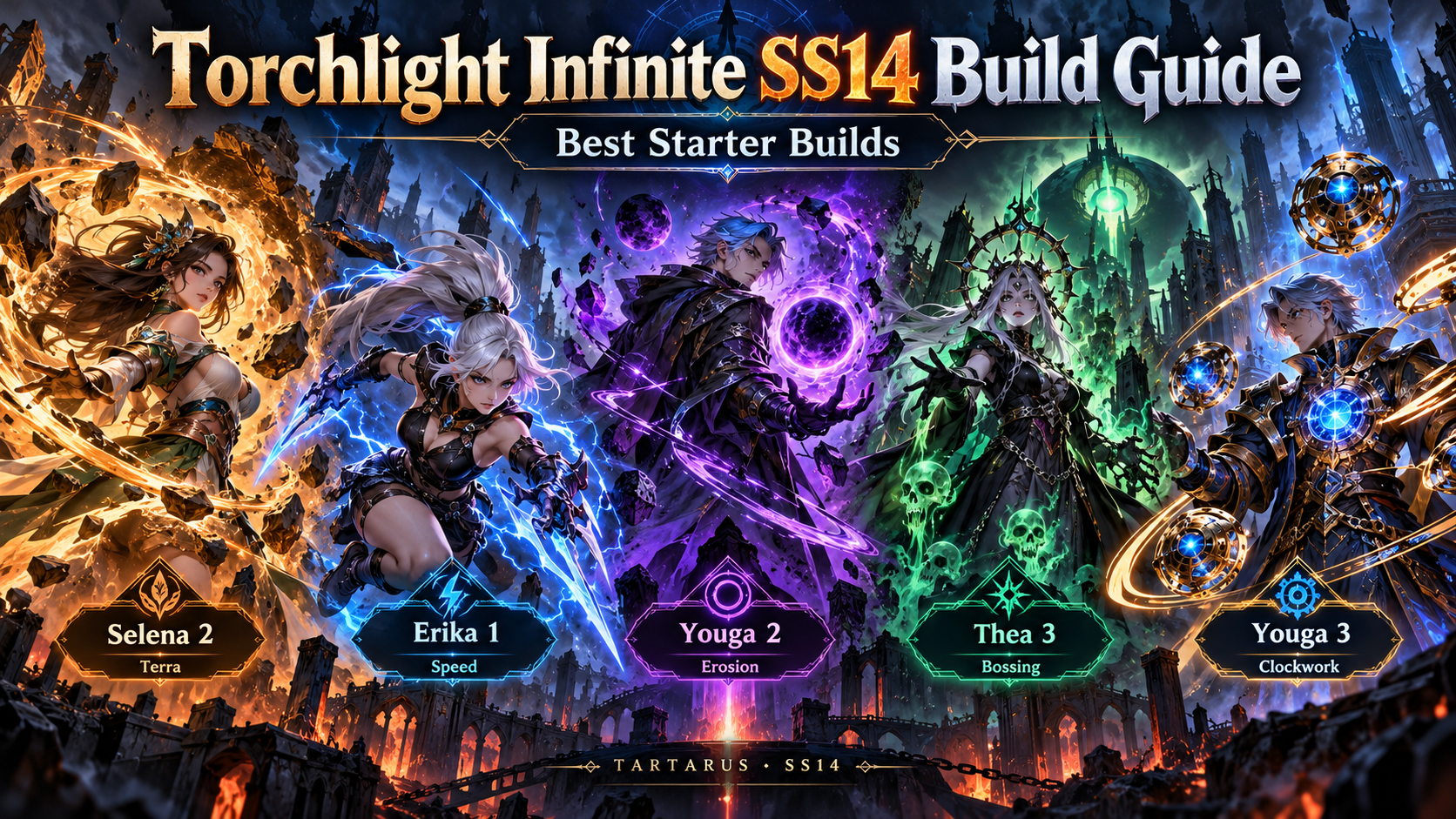
The following builds are worth considering for Tartarus. Their strengths are based on established build mechanics, SS13 results, community guides, and SS14 balance information—not a finalized ranking of Season 14 performance.
| Hero Build | Main Strength | Recommended For | Main Limitation |
|---|---|---|---|
|
Selena 2 – Dance of the Deep |
Mobile Terra damage |
Beginners, mapping |
SS14 Terra damage nerf |
|
Erika 1 – Wind Stalker |
Fast Multistrike attacks |
Speed farming |
Vulnerable to heavy hits |
|
Youga 2 – Spacetime Elapse |
Erosion damage over time |
Budget bossing |
Requires Reap synergy |
|
Thea 3 – Blasphemer |
Erosion damage and Desecration |
Elite and boss fights |
Less efficient at wide-area clearing |
|
Youga 3 – The Ultimate One |
Clockwork Core spellcasting |
Experimental spell builds |
New mechanics and uncertain gear costs |
These are different build archetypes rather than interchangeable versions of the same character. Players should choose according to their preferred combat style and available budget.
1. Selena 2 – Dance of the Deep: Mobile Terra Build
Selena’s second Hero Trait, Dance of the Deep, is an accessible choice for players who prefer spellcasting while moving.
Its defining feature allows a main Terra skill to remain centered on Selena and follow her movement. Instead of repeatedly stopping to cast spells, the character can maintain damage coverage while navigating groups of enemies.
Recommended Skills and Talents
The build should focus on one primary Terra damage skill, supported by mechanics that improve its effectiveness.
Terra Charges play an important role in the damage system, so charge generation and recovery should be considered when selecting Hero Traits and upgrades.
The Layered Hem trait is one progression option associated with improving Terra Charge recovery. Players should also evaluate movement speed, defensive recovery, and the coverage provided by their chosen Terra skill.
Gear Priorities
Focus on equipment providing spell damage, modifiers appropriate to the selected Terra skill, survivability, and useful movement bonuses.
During the campaign, prioritize maximum life, elemental resistance, and functional skill combinations over expensive legendary equipment.
SS14 Balance Warning
Dance of the Deep received a direct adjustment in SS14. Its additional Terra Skill Damage modifier changed from a progression range of +0% to +20% to a range of -20% to 0%, depending on trait level.
This makes it particularly important to check current-season damage calculations rather than relying on SS13 demonstrations.
Best for: Players who value mobility and straightforward map clearing, while accepting the need to compensate for the season’s Terra damage adjustment.
2. Erika 1 – Wind Stalker: Thunderspike Lightning Build
Erika 1 is a promising option for players who enjoy fast movement and repeated attacks.
The Wind Stalker Hero Trait rewards movement and interacts with Multistrike, a mechanic that allows attacks to repeat. A lightning-based Thunderspike configuration can use these repeated attacks to deal sustained damage while quickly moving between enemy groups.
Recommended Skill Setup
A documented endgame configuration uses Thunderspike as its main attack, with Steamroll and Electric Overload as supporting skills.
Spiral Strike provides mobility, while Bull’s Rage contributes to melee damage. Timid can be used as a curse, with offensive passive skills such as Cruelty and Fearless complementing the attack-focused setup.
The combat approach is relatively simple: reposition with Spiral Strike, maintain the relevant movement benefits, attack during safe openings, and move again when enemies threaten the character.
Talent and Gear Priorities
Because Thunderspike is an attack-based build, weapon damage matters significantly.
Prioritize physical and lightning damage that supports the attack’s conversion mechanics, Multistrike, attack speed, critical strike scaling, and defensive attributes.
Claws with appropriate damage modifiers are one equipment direction. Certain configurations also use legendary items and specialized modifiers for additional damage, but those purchases should come after the main attack setup functions reliably.
Leveling Strategy
A documented Erika 1 campaign route begins with Thunder Slash, changes to Berserking Blade at level 7, and transitions to Spectral Slash around level 20 before assembling the endgame Thunderspike configuration.
This illustrates an important principle: the best leveling skill does not always need to be the final endgame skill.
Erika 1 can be an effective currency-farming candidate, but the character needs adequate defenses to survive more dangerous encounters.
Best for: Players who prioritize active gameplay, fast mapping, and efficient currency farming.
3. Youga 2 – Spacetime Elapse: Mind Control Build
Youga 2 focuses on damage-over-time mechanics rather than repeated direct attacks.
A Mind Control build applies continuous Erosion damage, while its supporting mechanics enhance sustained damage against enemy groups and powerful individual targets.
The Spacetime Elapse Hero Trait complements this approach through interactions with recorded damage over time.
Main Skill and Support Setup
Mind Control is the primary damage skill.
An important SS14 consideration involves Controlled Spell. Its revised additional-damage effect applies to hits, making it unsuitable as a direct replacement for the older damage-over-time interaction in this configuration.
Empowered Channeling is a relevant alternative. Pain Amplification is another option, particularly when its Affliction requirements can be maintained.
Players should examine the actual conditions attached to each support rather than selecting skills based solely on their displayed damage multipliers.
Weapon and Talent Priorities
Scepters carrying the Reap modifier are especially important because Reap supports the build’s damage and talent interactions.
Psychic talents can help generate Blur through Reap, allowing the character to maintain effects during prolonged encounters rather than relying exclusively on enemy defeats.
A documented progression starts with Goddess of Deception and Forbidden Power, develops Reap-dependent Blur generation through Psychic, and later considers Subtle Impact.
Sentinel and Last Stand provide an additional route for scaling damage through block-related mechanics in more developed configurations.
Defensive Setup
During the campaign, maximum life and elemental resistance are practical priorities.
Later versions may transition toward energy shield when the required equipment, life-sealing mechanics, and recovery tools are available.
Switching into an energy-shield configuration without sufficient recovery or supporting gear can reduce survivability.
Best for: Players who enjoy damage-over-time gameplay and want a build with a structured progression path toward boss encounters.
4. Thea 3 – Blasphemer: Erosion Bossing Build
Thea 3 is another option for players interested in Erosion damage.
Her Blasphemer Hero Trait uses Desecration to pressure important targets, with additional interactions involving explosions and damage amplification.
This makes the character especially interesting for elite encounters and boss-focused farming.
How the Build Works
Blasphemer can apply Desecration to a nearby high-priority enemy. As the Hero Trait develops, additional effects improve how Desecration spreads and how enemies receive Erosion damage.
The build benefits from concentrating its damage mechanics rather than combining unrelated damage types.
Skills and Equipment
Haunting Abomination is one documented campaign skill for Blasphemer Thea. However, players should use an SS14-compatible skill and support configuration when moving beyond the campaign.
Useful equipment priorities include Erosion damage scaling, relevant skill modifiers, life or energy shield, and elemental resistances.
Thea 3 can be a strong choice for players who prefer eliminating priority targets, although faster movement-oriented characters may be more comfortable for continuous map clearing.
Best for: Players focused on elites, boss encounters, and Erosion-based gameplay.
5. Youga 3 – The Ultimate One: Clockwork Core Build
Youga 3 is the major new Hero Trait introduced in SS14 Tartarus.
Unlike Youga 2, which focuses on damage over time, The Ultimate One uses the Clockwork Core to control spellcasting.
Spell Tangles orbit the Core and cast the spell loaded into it. The mechanic creates opportunities for automated spell attacks, projectile interactions, and cooldown management.
Core Mechanics
The Ultimate One offers three development directions.
Spacetime Dictator emphasizes a domain in which projectiles can pierce enemies and return from its boundaries.
Spacetime Conqueror involves teleportation and links that transfer damage between enemies.
Spacetime Overlord modifies certain spells through special effects and interactions.
These directions allow different styles of spellcasting, although the ideal combination depends on the selected main skill and available equipment.
Recommended Build Priorities
Critical strike reliability matters because critical hits associated with the Clockwork Core contribute to cooldown recovery.
Projectile behavior, spell coverage, casting interactions, and survivability should be considered together.
For example, additional spell damage provides limited value if the selected spell cannot reliably hit its intended targets.
Because Youga 3 is a newly introduced trait, players should check current build demonstrations before purchasing expensive equipment for a specialized configuration.
Best for: Experienced players who want to explore the new Clockwork Core system and experiment with different spell combinations.
Torchlight Infinite SS14 Leveling and Gear Progression
A successful season starter needs a practical progression strategy. Expensive late-game equipment is not required to complete the early campaign, and purchasing specialized items too early may delay important defensive upgrades.
| Progression Stage | Main Goal | Upgrade Priority |
|---|---|---|
|
Early campaign |
Establish a reliable main skill |
Weapons, skill supports, life |
|
Mid-campaign |
Improve damage and survivability |
Talent synergy, resistances, movement |
|
Campaign completion |
Prepare for endgame systems |
Hero Memories, functional skill links |
|
Early Netherrealm |
Farm equipment and currency |
Main damage modifiers, defenses |
|
Timemark 7 |
Improve boss consistency |
Single-target damage, recovery |
|
Timemark 8 and beyond |
Optimize farming efficiency |
Advanced gear, Slates, Followers |
Step-by-Step Build Optimization
- Choose one main damage skill. Select a skill that works with your Hero Trait and available equipment.
- Build around compatible damage modifiers. Avoid mixing unrelated physical, elemental, and damage-over-time bonuses unless the build explicitly uses conversion mechanics.
- Upgrade survivability alongside damage. Maintain appropriate resistances and recovery rather than concentrating exclusively on damage output.
- Strengthen the main skill before secondary abilities. Supporting attacks, buffs, and utility skills should improve the primary damage engine.
- Use the Auction House selectively. Prioritize affordable upgrades that solve immediate problems instead of chasing expensive equipment with marginal improvements.
- Test against bosses and the Training Dummy. Verify whether upgrades improve practical damage and survivability before committing additional resources.
As players advance, Divinity Slates, Hero Memories, and Pactspirits offer additional ways to refine a build. However, their value depends on the underlying skill and talent configuration.
A well-balanced build with moderate damage and reliable defenses may complete more encounters than a fragile character displaying significantly higher theoretical DPS.
How SS14 Tartarus Mechanics Affect Build Choices
Tartarus introduces seasonal content centered on capturing prisoners, managing a prison, and confronting the enemies developed through those systems.
The season also introduces recruitable Followers that can support players through combat abilities.
Followers and Build Synergy
Followers are available in four species: Lion Queen, Lone Wolf, Mammoth, and Witch Rat.
Higher-quality Followers can provide additional skill slots and stronger active skills.
Certain Follower abilities can grant buffs, apply debuffs, or provide utility effects, so their value depends on the player’s build.
For example, damage-oriented builds may benefit from a Follower providing appropriate offensive support, while fragile characters may find recovery or defensive utility more valuable.
Followers should complement the character’s existing strengths and weaknesses rather than replace essential equipment or defenses.
Preparing for Prison Riots
The Tartarus prison activity culminates in Riot encounters involving the inmates players have developed.
This makes it useful to prepare for both multiple enemies and sustained fights against stronger targets.
A build that clears ordinary Netherrealm maps quickly may still struggle when its single-target damage or defensive recovery is insufficient.
Before attempting more demanding seasonal encounters, confirm that the character can maintain damage against durable targets, survive dangerous attack patterns, and recover between incoming hits.
Important SS14 Balance Changes to Check
Season 14 includes several adjustments that may influence build performance.
| Skill or System | SS14 Change | Potential Build Impact |
|---|---|---|
|
Selena 2 – Dance of the Deep |
Reduced Terra Skill Damage modifier |
Lower damage contribution from the trait |
|
Chromatic Shot |
Adjusted base damage and Shotgun decay |
Requires reevaluation of previous damage setups |
|
Ice Lances |
Shotgun decay coefficient changed from 64% to 80% |
May affect multi-hit damage calculations |
|
Ice Lances: Rebound |
Increased support damage modifier |
Changes support comparisons |
|
Ice Lances: Bounce |
Increased support damage modifier |
Changes support comparisons |
|
Activation Medium: Sentry |
Trigger interval reduced from 0.2 to 0.1 seconds |
May improve compatible triggering setups |
|
False God’s Skin |
Drop threshold moved from Timemark 5 to Timemark 7 |
Changes availability during progression |
These adjustments demonstrate why SS13 build codes and damage calculations cannot automatically be treated as SS14 recommendations.
Players should check the current patch notes and any supplemental adjustments before investing heavily in a build.
How to Farm Currency Efficiently in SS14
Flame Elementium remains an important resource in Torchlight Infinite SS14, allowing players to purchase equipment and improve their builds through the Trade House.
Efficient currency farming depends on how quickly a character can complete content, survive difficult encounters, and collect valuable drops. Choosing the right farming strategy can significantly improve your overall progression.
For general farming, prioritize maps and activities that you can clear consistently instead of pushing the highest available difficulty regardless of performance. A player who repeatedly dies against difficult bosses may earn less currency than someone farming easier content at a steady pace.
When comparing farming strategies, consider map completion speed, equipment costs, death frequency, and the value of potential drops. Builds with excellent mobility and area damage often perform well in routine farming, while characters with stronger sustained damage may be better suited for challenging Tartarus Riot encounters.
For players who want to save time on grinding and focus on upgrading their characters, another option is to buy Torchlight Infinite SS14 Currency at U4GM. Whether you’re looking to upgrade your equipment or prepare for tougher endgame content, U4GM offers an alternative way to obtain in-game currency. Use the exclusive coupon code "z123" to enjoy 6% off your purchase.
Ultimately, combining efficient farming strategies with smart equipment investments can help you progress through Torchlight Infinite SS14 more smoothly and enjoy everything the Tartarus season has to offer.
Common Mistakes When Choosing an SS14 Build
One frequent mistake is copying a character setup from an older season without verifying the balance changes.
Another is selecting a powerful endgame build without checking the equipment required to make it functional. Some builds depend on specific legendary modifiers, talents, or interactions that are unavailable early in progression.
Players also sometimes focus too heavily on Training Dummy damage. Damage against a stationary target does not fully represent performance in encounters requiring constant repositioning.
Finally, avoid changing several expensive components simultaneously. Test important upgrades separately so their actual contributions can be measured.
Torchlight Infinite SS14 Build FAQ
What is the best starter build in Torchlight Infinite SS14?
Erika 1, Youga 2, Selena 2, and Thea 3 are established starting options. Erika 1 is particularly attractive for active speed farming, while Youga 2 offers a damage-over-time approach. Selena 2 remains easy to play but received a Terra damage nerf. There is not yet enough verified SS14 performance data to declare one universally superior.
Is Youga 3 worth playing in Season 14?
Yes, especially for players interested in experimenting with new mechanics. The Ultimate One introduces Clockwork Core spellcasting and several development paths. Its long-term performance and equipment requirements should be reassessed as more SS14 results become available.
Which SS14 build is good for beginners?
Selena 2 and Erika 1 are reasonable starting points for players who prefer relatively understandable gameplay mechanics. However, beginners should prioritize a complete leveling guide rather than copying only an expensive endgame configuration.
Which build is better for boss fights?
Youga 2 and Thea 3 are worth considering for boss-focused gameplay due to their established damage mechanics. Their effectiveness will still depend on equipment, talent choices, and specific encounter requirements.
Can old Torchlight Infinite builds still work in SS14?
Many older build concepts remain usable, but their exact skills, talents, damage calculations, and equipment priorities may need adjustments. Always verify current patch changes before importing an older build code.
About the Author