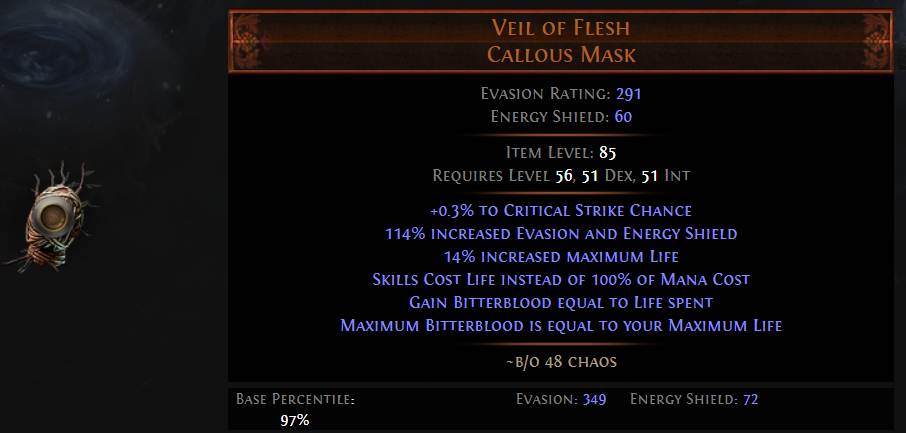
Veil of Flesh is a unique Callous Mask built around a life-cost spell setup. It changes how skills use resources: skills spend Life instead of Mana, and that Life spent becomes Bitterblood. Bitterblood absorbs part of incoming hit damage and, when depleted by a hit, grants Lamentation—a short buff that greatly improves spell critical strikes and area of effect.
This makes the helmet a natural fit for a spell build that can spend Life consistently, recover it reliably, and make good use of Lamentation’s critical bonuses.
Veil of Flesh Item Stats
Veil of Flesh
Callous Mask
- Quality: +20%
- Evasion Rating: 292–427
- Energy Shield: 60–87
- Requires Level 56, 51 Dexterity, 51 Intelligence
- +(0.3–0.5)% to Critical Strike Chance
- (100–160)% increased Evasion and Energy Shield
- (14–20)% increased maximum Life
- Skills Cost Life instead of 100% of Mana Cost
- Gain Bitterblood equal to Life spent
- Maximum Bitterblood is equal to your Maximum Life
- Flesh Barrier duration: 200 ms per 100 Barrier lost
- Flesh Barrier chance to trigger: 100%
- Minimum trigger threshold: 30% of Maximum Life
The item provides both increased Life and a mixed Evasion and Energy Shield bonus. Its main build-defining effects are the Life cost, Bitterblood generation, and Flesh Barrier trigger.
How Bitterblood Works
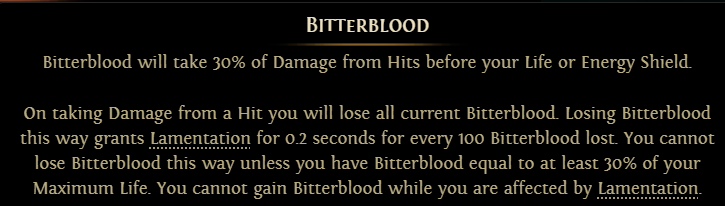
Bitterblood takes 30% of damage from hits before that damage reaches Life or Energy Shield. When you take a hit, you lose all current Bitterblood and gain Lamentation based on how much Bitterblood was lost. You need at least 30% of your Maximum Life in Bitterblood for a hit to trigger this loss. While Lamentation is active, you cannot gain Bitterblood.
Lamentation gives spells:
- +50% to Critical Strike Multiplier
- 100% increased Area of Effect
- 200% increased Critical Strike Chance
The helmet’s duration modifier grants 200 milliseconds of Lamentation for every 100 Bitterblood lost. For example, losing 1,000 Bitterblood gives a base duration of 2 seconds; losing 5,000 gives 10 seconds, before any other applicable modifiers.
Build Concept
The build has a repeating resource cycle:
- Cast spells that cost Life.
- Convert the Life spent into Bitterblood.
- Build Bitterblood to at least 30% of Maximum Life.
- Take a hit while above the threshold. Bitterblood absorbs its share of hit damage, is lost, and triggers Lamentation.
- Use the Lamentation window to deal increased spell damage, especially with a critical spell.
- Recover Life and rebuild Bitterblood for the next cycle.
The goal is to make Lamentation frequent enough to matter while keeping the character safe during the periods when Bitterblood is rebuilding or Lamentation prevents new Bitterblood gain.
Choosing a Skill
Choose a spell that benefits from spell critical chance, critical multiplier, and increased area of effect. A spell with good clear coverage can take advantage of Lamentation’s area bonus, while a high single-target spell can use its critical bonuses against bosses.
Since Veil of Flesh makes skills cost Life, check the skill’s actual cost and cast frequency. A spell that is too expensive or is cast too often can drain Life faster than the build can recover it. The supplied item stats do not specify a particular active skill, so the best choice depends on your preferred spell and the rest of your gear.
Passive Tree and Gear Priorities
Build around the helmet’s resource and buff cycle rather than treating it as a standard defensive helmet.
Life and Life Recovery
Maximum Life does several jobs: it improves the character’s Life pool and raises Bitterblood’s maximum capacity. Prioritize maximum Life, then add reliable Life recovery so you can pay skill costs and recover after taking damage.
Life regeneration, Life recovery from other sources, and recovery on kill can all help support the cycle. Make sure your recovery is sufficient for the skill’s cost during sustained casting.
Spell Damage and Critical Strikes
Lamentation already supplies a large temporary boost to spell critical chance and critical multiplier. Use the rest of the build to provide consistent damage outside that window, and improve the value of the buff with suitable spell damage and critical investment.
Avoid assuming that Lamentation alone caps your critical chance: the result depends on the selected skill, its base critical chance, and the character’s other stats.
Defenses
Bitterblood only applies to hits. It does not replace defenses against damage over time, and it should not be treated as a permanent shield. The build still needs a strong defensive foundation, such as capped elemental resistances, suitable mitigation, and enough Life recovery to handle the health cost of casting.
The helmet’s Evasion and Energy Shield modifiers can support an evasion-based or hybrid setup, but they do not by themselves make the character durable.
Managing the Cycle
The most important threshold is 30% of Maximum Life in Bitterblood. Below it, a hit will not trigger the Bitterblood loss described by the item. Casting enough Life-cost skills to pass that threshold prepares the Lamentation trigger, but spending Life carelessly can leave too little Life to survive incoming damage.
During Lamentation, Bitterblood cannot be gained. Treat that time as a damage window: keep attacking with the selected spell, then allow the buff to end and rebuild Bitterblood. If the buff lasts longer than the encounter requires, reduce unnecessary Life spending and focus on staying alive.
Strengths and Limitations
Strengths
- Strong temporary spell critical chance, critical multiplier, and area of effect
- Life spent on skills also builds Bitterblood
- Bitterblood can absorb part of hit damage before Life or Energy Shield
- Increased maximum Life benefits both survivability and Bitterblood capacity
Limitations
- Skills consume Life, so casting requires dependable Life recovery
- Bitterblood must reach 30% of Maximum Life before a hit can trigger its loss
- No Bitterblood can be gained during Lamentation
- The defensive effect applies to hits, so damage over time still needs to be managed separately
- The helmet does not define a complete skill setup; the active spell and supporting gear must be chosen to fit the build
Final Build Notes
Veil of Flesh works best as the centerpiece of a Life-cost spell build with deliberate control over its casting, recovery, and hit timing. Build enough Life to increase Bitterblood capacity, sustain the spell’s Life cost, and remain safe while the resource cycle resets. Then use Lamentation’s short but powerful spell bonuses as the build’s main burst window.
About the Author