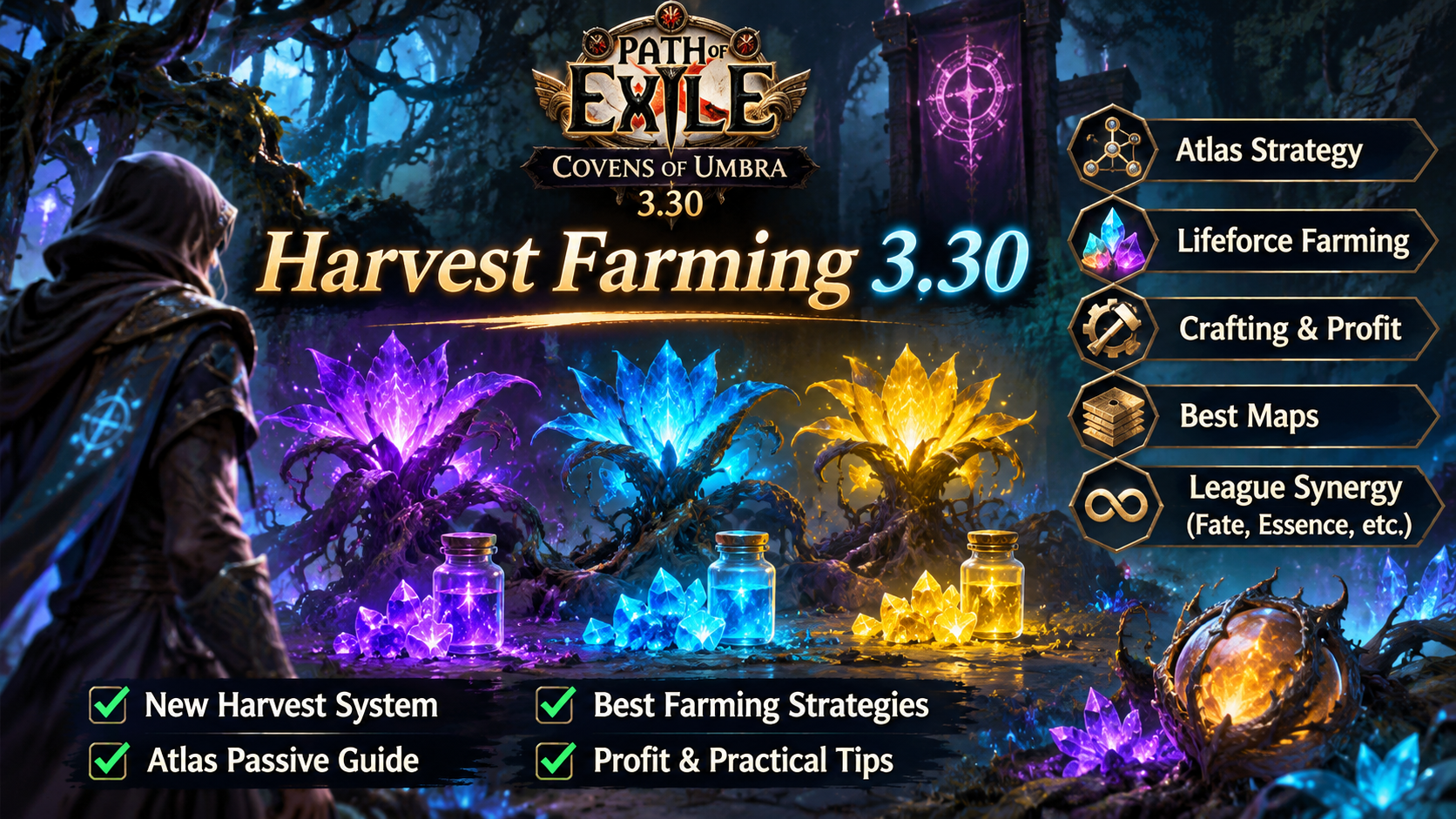
Harvest has received a major rework in Path of Exile 3.30: Covens of Umbra. Instead of entering the Sacred Grove and choosing between different plots of crops, players now encounter Sacred Flora directly inside maps.
The new system makes Harvest easier to combine with regular mapping, Atlas progression, Fate farming and other league mechanics. Crystallised Lifeforce remains a valuable source of currency income and crafting materials, making Harvest an attractive farming strategy for both Trade League and Solo Self-Found (SSF) players.
However, many popular Harvest farming strategies from previous leagues are no longer applicable. Crop Rotation has been removed, Harvest Scarabs are gone, and Atlas investment works differently.
This guide explains how to farm Harvest efficiently in PoE 3.30, which Atlas passives to prioritize, which Lifeforce colors to target, and how to maximize your farming profits.
1. Harvest Changes in PoE 3.30
Harvest was originally introduced in Path of Exile 3.11 on June 19, 2020. Since then, the mechanic has undergone several major changes, including the introduction of tradable Lifeforce and the removal of the original garden management system.
The 3.30 update fundamentally changes how players encounter and farm Harvest.
|
Feature |
Before 3.30 |
PoE 3.30 |
|---|---|---|
|
Harvest location |
Sacred Grove subarea |
Directly inside maps |
|
Harvest encounters |
Pairs of crop plots |
Sacred Flora |
|
Harvest monsters |
Harvest Monsters |
Sacred Fauna |
|
Lifeforce colors |
Wild, Primal and Vivid |
Wild, Primal and Vivid |
|
Tier 1 monsters |
Could drop Lifeforce |
No Lifeforce drops |
|
Tier 2 monsters |
Higher drop probability |
Reduced drop probability |
|
Lifeforce stacks |
More individual drops |
Larger stacks |
|
Harvest bosses |
Tier 4 crops |
Sacred Specimens in high-tier maps |
|
Crop Rotation |
Available |
Removed |
|
Harvest Scarabs |
Available |
Removed |
|
Harvest Threads |
Not applicable |
No dedicated Harvest Thread |
|
Additional mechanic |
Traditional crop harvesting |
Wildwood Wisp distribution |
The developers intended the Lifeforce drop changes to reduce the number of items players need to pick up while keeping overall rewards at a similar level.
References:
2. How Harvest Works in PoE 3.30
Sacred Flora
Sacred Flora are interactable plants that can appear throughout Atlas maps. Each Sacred Flora is associated with one of three Lifeforce types.
|
Sacred Flora type |
Color |
Primary reward |
|---|---|---|
|
Wild |
Purple |
Wild Crystallised Lifeforce |
|
Primal |
Blue |
Primal Crystallised Lifeforce |
|
Vivid |
Yellow |
Vivid Crystallised Lifeforce |
Activating Sacred Flora causes monsters called Sacred Fauna to emerge from nearby roots. Defeating these monsters generates Lifeforce rewards.
After most of the monsters have been defeated, the Sacred Flora also releases Wildwood Wisps associated with its color, potentially improving subsequent monster encounters within the map.
Sacred Fauna
Sacred Fauna are the monsters associated with Harvest encounters. Their tiers influence the potential rewards.
- Tier 1: No longer drops Lifeforce in 3.30.
- Tier 2: Has a reduced chance of dropping Lifeforce.
- Tier 3: An important target for regular Lifeforce farming.
- Harvest bosses: More challenging encounters with additional reward potential.
This makes Atlas passives that improve monster tiers and duplication particularly relevant for dedicated Harvest farmers.
Sacred Specimens
In higher-tier maps, Sacred Flora can be replaced by Sacred Specimens.
Interacting with a Sacred Specimen summons a Harvest boss rather than a regular Sacred Fauna encounter.
These encounters are particularly interesting for players with strong single-target damage who want to combine ordinary Lifeforce farming with boss rewards.
How to Complete a Harvest Encounter
- Enter an Atlas map.
- Locate Sacred Flora while exploring.
- Examine its color and available modifiers.
- Activate the Sacred Flora.
- Defeat the Sacred Fauna.
- Collect the Lifeforce near the base of the plant after completing the encounter.
- Continue clearing the map and benefiting from the released Wildwood Wisps.
Patch 3.30.0d changed Lifeforce collection so that the rewards appear together around the plant when the encounter finishes, making looting more convenient.
3. Best Harvest Atlas Passive Tree in PoE 3.30
Unlike previous leagues, Harvest farming now relies heavily on the Sacred Flora clusters in the Atlas Passive Tree rather than Scarabs.
Your primary objectives should be to increase encounter frequency, Lifeforce quantity, monster tiers and reward duplication.
Best Harvest Atlas Passives
|
Atlas passive |
Effect |
Priority |
|---|---|---|
|
Call of the Grove |
+40% Surpassing Chance to encounter Sacred Flora |
Essential |
|
Sacred Flora Chance |
+15% Surpassing Chance per node |
Essential |
|
Doubling Season |
15% chance to duplicate Lifeforce drops |
Essential |
|
Additional Lifeforce |
6% increased Lifeforce quantity per node |
Essential |
|
Tier 3 Monster Chance |
10% increased chance of Tier 3 Sacred Fauna per node |
Very High |
|
Sacred Fauna Duplication Chance |
3% monster duplication chance per node |
High |
|
Arboriculture |
100% increased chance to encounter the selected Sacred Flora type |
High |
|
Rich Soil |
Increases Sacred Flora explicit modifier effect by 50% |
High |
|
Heart of the Grove |
50% increased Harvest boss chance; prevents Normal-rarity Sacred Flora |
High |
|
Bountiful Harvest |
Allows Wisps to affect Rare and Unique monsters; doubles Sacred Fauna experience |
Situational |
|
Sacred Flora Wisp Quantity |
Increases Wisp quantity and distribution |
Situational |
|
Nature’s Favour |
Improves Wisp distribution to imprisoned monsters |
Situational |
Source: PoEDB – Sacred Flora Atlas Passive Skills .
Recommended Atlas Passive Allocation Order
For a dedicated Lifeforce farming strategy, prioritize:
- Call of the Grove
- Sacred Flora Chance
- Additional Lifeforce
- Doubling Season
- Tier 3 Monster Chance
- Arboriculture
- Sacred Fauna Duplication Chance
- Rich Soil
- Heart of the Grove
- Additional mapping and league mechanics
Investing in encounter frequency first provides more opportunities to benefit from every other Harvest passive.
Understanding Surpassing Chance
Surpassing Chance is particularly important in the redesigned Atlas.
Unlike an ordinary probability, Surpassing Chance can exceed 100%, allowing additional encounters to appear.
|
Surpassing Chance |
Encounter expectation |
|---|---|
|
50% |
50% chance of one encounter |
|
100% |
One guaranteed encounter |
|
150% |
One encounter and a 50% chance of another |
|
200% |
Two guaranteed encounters |
|
250% |
Two encounters and a 50% chance of a third |
|
300% |
Three guaranteed encounters |
Increasing Sacred Flora encounter frequency is one of the most straightforward ways to improve Lifeforce income without significantly increasing your investment per map.
4. Best Lifeforce Color to Farm in PoE 3.30
In previous leagues, Vivid Crystallised Lifeforce was frequently the preferred farming target because of its association with Divination Card gambling.
However, changes to Horticrafting costs in 3.30 create additional demand for all three colors.
|
Lifeforce |
Color |
Farming considerations |
|---|---|---|
|
Vivid Crystallised Lifeforce |
Yellow |
Popular crafting resource and Divination Card gambling |
|
Wild Crystallised Lifeforce |
Purple |
Various Harvest crafting recipes and gambling |
|
Primal Crystallised Lifeforce |
Blue |
Various Harvest crafting recipes and gambling |
|
Sacred Crystallised Lifeforce |
White |
Rare resource for advanced Harvest crafting |
Harvest Crafting Cost Changes
|
Crafting option |
Previous cost |
PoE 3.30 cost |
|---|---|---|
|
Resistance conversion |
500 of one Lifeforce type |
300 each of two types |
|
Damage type conversion |
500 Lifeforce + Crystallised Rancour |
300 each of two types + Crystallised Rancour |
|
Divination Card gambling |
1,500 Vivid |
1,000 Vivid + 1,000 Wild + 1,000 Primal |
The revised Divination Card gambling recipe now consumes 3,000 total Lifeforce, distributed equally among the three ordinary colors.
Consequently, yellow Lifeforce is no longer automatically the best farming target.
How to Choose the Most Profitable Lifeforce
Before starting a farming session, check current exchange rates using:
Select the appropriate Arboriculture option:
- Vivid Roots: Increased chance of encountering yellow Sacred Flora.
- Wild Roots: Increased chance of encountering purple Sacred Flora.
- Primal Roots: Increased chance of encountering blue Sacred Flora.
Compare actual Lifeforce prices and your average farming yield rather than assuming one color will remain the most profitable throughout the league.
5. Atlas Drops, Item Rarity and Pack Size
PoE 3.30 replaces the Item Quantity stat on map modifiers with Atlas Drops.
According to the 3.30 patch notes, Atlas Drops affects league-specific resources, including Lifeforce obtained from Harvest monsters.
This makes Atlas Drops an important consideration when rolling maps.
|
Map statistic |
Importance |
Reason |
|---|---|---|
|
Atlas Drops |
Very High |
Directly affects Lifeforce rewards |
|
Sacred Flora encounter chance |
Very High |
Generates additional Harvest encounters |
|
Monster Pack Size |
Worth testing |
May improve overall mapping returns |
|
Item Rarity |
Secondary |
Improves broader mapping loot |
|
Map tier |
High |
Provides access to more challenging encounters and Harvest bosses |
|
Map layout |
Very High |
Determines farming speed and accessibility |
Do not automatically apply Lifeforce scaling formulas from previous leagues to Sacred Flora in 3.30.
When testing maps, compare actual Lifeforce obtained per hour across different Atlas Drops values and difficulty levels.
6. Sacred Flora Modifiers and Rerolling Strategy
One of the more interesting changes in PoE 3.30 is the ability to modify Sacred Flora encounters.
Sacred Flora can have their own explicit modifiers, allowing players to improve potential rewards or reroll undesirable encounters.
The Rich Soil Atlas notable is particularly useful because it increases the effectiveness of these modifiers by 50%.
What Modifiers Should You Target?
For a Lifeforce-focused strategy, look for modifiers that improve:
- Lifeforce quantity.
- Higher-tier Sacred Fauna encounters.
- The number or duplication of monsters.
- Additional valuable rewards.
For advanced farming strategies, Sacred Flora can also be targeted for alternative rewards such as Threads and Stacked Decks. Community farming reports have identified dedicated Sacred Flora rerolling as a potentially profitable alternative to ordinary Lifeforce farming.
When Should You Stop Rerolling?
The objective is not to create the perfect Sacred Flora at any cost.
For example, if you spend 15 Chaos Orbs rerolling a plant but receive only 10 Chaos Orbs of additional rewards, the rerolling strategy loses money.
Set a maximum investment per plant based on your farming results. Accept reasonably valuable modifiers rather than repeatedly spending currency chasing a perfect combination.
7. Best Maps for Harvest Farming in PoE 3.30
Harvest no longer requires players to enter a separate instance. Map layout therefore has a greater influence on farming efficiency.
Good Harvest maps should have:
- Open or linear layouts.
- Minimal backtracking.
- Easily accessible Sacred Flora.
- Manageable boss encounters.
- Fast overall completion times.
|
Map |
Layout characteristics |
Farming suitability |
|---|---|---|
|
Dunes |
Large open areas |
Excellent |
|
Beach |
Relatively straightforward progression |
Excellent |
|
Strand |
Linear layout |
Excellent |
|
Jungle Valley |
Straightforward routing |
Very Good |
|
Mesa |
Accessible boss encounter |
Very Good |
|
City Square |
Compact layout |
Very Good |
|
Cemetery |
Open terrain |
Very Good |
|
Toxic Sewer |
Narrow passages |
Good for suitable builds |
These are layout-based recommendations rather than confirmed map-specific Harvest bonuses. Choose maps available on your Atlas that suit your character’s movement and clearing abilities.
What Is the Best Map Tier?
|
Map tier |
Recommended for |
|---|---|
|
Tier 1–5 |
League starters and undergeared characters |
|
Tier 6–10 |
Developing characters |
|
Tier 11–15 |
Intermediate Harvest farming |
|
Tier 16 |
Dedicated Lifeforce farming |
|
Higher-difficulty endgame maps |
Highly optimized characters |
For most established characters, Tier 16 maps are a sensible starting point for dedicated Harvest farming.
However, running lower-tier maps quickly can be more profitable than struggling through higher-tier content.
8. Harvest Farming and Wildwood Wisps
Sacred Flora now releases Wildwood Wisps into the map after players defeat most of its associated monsters.
These Wisps provide an additional reason to combine Harvest with other mapping strategies.
Wildwood Wisp Types
|
Wisp |
Color |
General benefit |
|---|---|---|
|
Wild Wisps |
Purple |
Improved item rarity |
|
Primal Wisps |
Blue |
Additional currency rewards |
|
Vivid Wisps |
Yellow |
Improved item quantity |
Important Changes in Patch 3.30.0c
Following the 3.30.0c update:
- Sacred Flora normally distributes Wisps only to Normal and Magic monsters.
- Bountiful Harvest allows Wisps to empower Rare and Unique monsters.
- Nature’s Favour improves Wisp distribution to imprisoned monsters.
Players who want to focus on Wisp-enhanced Rare and Unique monsters should allocate Bountiful Harvest.
Source: Official PoE 3.30.0c Patch Notes .
Should You Activate Sacred Flora First?
When practical, complete Harvest encounters before clearing nearby monsters. This leaves more potential targets for the released Wisps.
However, excessive backtracking is generally inefficient. Treat Wisps as an additional source of mapping rewards rather than sacrificing your entire farming route to maximize their distribution.
9. Best League Mechanics to Combine with Harvest
Harvest is a secondary mechanic in PoE 3.30, making it relatively easy to combine with other farming strategies.
|
Mechanic |
Synergy |
Investment |
|---|---|---|
|
Essence |
Crafting materials and imprisoned monsters |
Low |
|
Shrines |
Faster clearing and improved character power |
Low |
|
Covens |
Fate rewards and Viscera from empowered bosses |
Low |
|
Eldritch Altars |
Additional mapping rewards |
Low |
|
Bestiary |
Valuable beasts and additional encounters |
Medium |
|
Breach |
Additional monsters and league resources |
Medium |
|
Expedition |
Currency and crafting opportunities |
Medium |
|
Mirage |
Additional encounter opportunities |
Medium |
|
Ritual |
Additional reward selection |
Medium–High |
Harvest + Essence
This is an attractive combination for players seeking consistent income from crafting materials.
Essences and Lifeforce are both useful for crafting equipment and can be sold in bulk.
Nature’s Favour is also relevant because it directs more Wildwood Wisps toward imprisoned monsters.
The main advantage is relatively low investment. The primary disadvantage is that heavily empowered Essence monsters may take longer to defeat.
Harvest + Shrines
Shrines are particularly useful for characters that need additional damage, movement speed or defensive power.
This combination is suitable for:
- League starters.
- Fast mapping characters.
- Players with limited investment budgets.
- Characters that struggle against powerful Sacred Fauna.
- Players focusing on experience and currency simultaneously.
Shrines do not directly guarantee additional Lifeforce, but faster map completion can improve overall farming efficiency.
Harvest + Breach
Breach provides additional monsters and its own league-specific rewards.
This combination is more suitable for characters with strong area damage and excellent clear speed.
Use Breach Threads to enhance Breach encounters while allocating Sacred Flora passives to improve Harvest.
Track the profitability of both mechanics separately before increasing your Thread investment.
Harvest + Mirage
Mirage offers additional mapping opportunities and can be a useful combination when its encounters reproduce Harvest content.
Players interested in this strategy should investigate Atlas passives such as Fata Morgana and Blended Realities.
The additional time spent inside Mirage encounters should be justified by their actual rewards.
10. Harvest and Fate Farming in Covens of Umbra
Fates are the central league mechanic of Path of Exile 3.30.
Players can disrupt Coven rituals, select Fates and empower area bosses with additional abilities, modifiers and rewards.
Harvest and Fate farming can be combined because both take place during regular mapping.
For more information, see Fate – PoE Wiki .
Recommended Fate Selection
|
Fate reward |
Farming priority |
|---|---|
|
Divine Orbs |
Very High |
|
Other valuable currency |
Very High |
|
Valuable equipment modifiers |
High |
|
Valuable Viscera opportunities |
High |
|
Additional rewards from companion bosses |
Build-dependent |
|
Low-value equipment |
Low |
Always examine the displayed rewards before invoking a Fate. The value of a particular Fate depends on its reward outcome, combination and the difficulty it adds to the boss encounter.
Fate Empowerment Effects to Consider
|
Fate |
Potential difficulty |
|---|---|
|
Sanguine |
Boss life regeneration |
|
Deathbringer |
Increased maximum life |
|
Doomsayer |
Fire resistance and fire damage |
|
Stormcaller |
Lightning damage and Shock |
|
Conjurer |
Physical and Chaos damage, Withered |
|
Houndmaster |
Brittle and increased critical strike potential |
|
Savage |
Additional companion boss |
|
Pestilent |
Additional companion boss |
|
Sadist |
Additional companion boss |
For example, a fire-based character may have difficulty defeating a boss empowered by Doomsayer, while a character with insufficient single-target damage may struggle against Sanguine.
Fates should be selected according to your build rather than reward value alone.
Recommended Harvest and Fate Farming Loop
- Prepare a batch of maps.
- Enter a map and locate Sacred Flora.
- Complete Harvest encounters.
- Disrupt Coven rituals when encountered.
- Select valuable Fates that your build can handle.
- Defeat the empowered map boss.
- Collect Lifeforce, Fate rewards and any Viscera obtained.
- Repeat the process.
Harvest and Fates provide complementary income sources. However, Fates should not be treated as a direct multiplier to Sacred Flora Lifeforce drops unless a specific reward or modifier explicitly provides that benefit.
Additional Fate information: PoE 3.30 Fate Effects and Rewards .
11. Best Harvest Farming Strategies by Investment Level
Strategy 1: Low-Investment Harvest Farming
Recommended for league starters, casual players and developing characters.
|
Configuration |
Recommendation |
|---|---|
|
Maps |
Highest tier you can clear efficiently |
|
Map rolling |
Orb of Alchemy or affordable modifiers |
|
Atlas investment |
Sacred Flora chance and Lifeforce quantity |
|
Arboriculture |
Highest-value Lifeforce color |
|
Additional mechanics |
Shrines and Essence |
|
Threads |
Optional; none required for Harvest |
|
Sacred Flora rerolling |
Minimal |
|
Fate selection |
Easy encounters with valuable rewards |
The main objective is to generate consistent currency without spending heavily on map preparation.
Sell most of your Lifeforce and reinvest the proceeds into equipment upgrades.
Strategy 2: Tier 16 Lifeforce Farming
Recommended for established endgame characters.
|
Configuration |
Recommendation |
|---|---|
|
Maps |
Tier 16 |
|
Map layout |
Open or linear |
|
Map modifiers |
High Atlas Drops with manageable difficulty |
|
Atlas investment |
Dedicated Harvest reward clusters |
|
Arboriculture |
Based on current market prices |
|
Sacred Flora modifiers |
Prioritize Lifeforce rewards |
|
Additional mechanics |
Eldritch Altars, Shrines and Covens |
|
Harvest bosses |
Complete when time-efficient |
This is a balanced strategy for players looking to combine reasonable investment, consistent income and endgame progression.
Strategy 3: High-Investment Harvest Farming
Recommended for powerful characters and experienced players.
|
Configuration |
Recommendation |
|---|---|
|
Maps |
High-tier, heavily modified maps |
|
Atlas investment |
Harvest, Rich Soil and supporting mechanics |
|
Sacred Flora rerolling |
Target high-value reward modifiers |
|
Additional mechanics |
Mirage, Breach or Bestiary |
|
Harvest bosses |
Prioritize when profitable |
|
Fate encounters |
Valuable combinations |
|
Currency investment |
Based on measured returns |
High-investment farming can produce excellent rewards, but expensive map preparation and Sacred Flora rerolling can significantly reduce net profits.
Test this strategy over a meaningful number of maps before committing large amounts of currency.
12. Harvest Boss Farming
High-tier maps can contain Sacred Specimens that summon Harvest bosses.
The traditional Harvest boss roster includes:
|
Boss |
Associated Lifeforce |
Potential exclusive unique |
|---|---|---|
|
Ersi, Mother of Thorns |
Wild |
Bear’s Girdle |
|
Janaar, the Omen |
Primal |
Plume of Pursuit |
|
Namharim, Born of Night |
Vivid |
The Felbog Fang |
These bosses are historically associated with Sacred Blossom drops, which provide access to Oshabi.
The 3.30 rework confirms the new Sacred Specimen encounter system, but older boss drop rates should not be assumed to remain identical.
Oshabi, Avatar of the Grove
Oshabi is the pinnacle encounter associated with Harvest.
Players can use a Sacred Blossom in the Map Device to access this boss encounter.
Potential rewards include:
- Sacred Crystallised Lifeforce.
- Forbidden Shako.
- Other Harvest-exclusive unique items.
- Additional boss loot.
Sacred Crystallised Lifeforce is particularly valuable because it is required for certain advanced Harvest crafting options.
Before purchasing Sacred Blossoms for dedicated boss farming, compare their market price with the expected value of Oshabi’s rewards.
Useful references:
13. How to Unlock and Use the Horticrafting Station
In PoE 3.30, the old Harvest tutorial quest has been removed.
The Horticrafting Station hideout decoration becomes available after completing your first Sacred Flora encounter.
Once unlocked, you can place the station in your hideout and spend collected Lifeforce on various crafting options.
Popular Harvest Crafting Uses
|
Crafting purpose |
Application |
|---|---|
|
Resistance conversion |
Adjust elemental resistances on equipment |
|
Modifier reforging |
Craft equipment with selected modifier categories |
|
Damage type conversion |
Change eligible damage modifiers |
|
Advanced crafting |
Improve high-value equipment |
|
Divination Card gambling |
Gamble cards for a chance to increase their quantity |
See Harvest Crafting Options – PoE Wiki .
Remember to check the actual crafting costs displayed at the Horticrafting Station, as some older crafting guides contain outdated prices.
Sell Lifeforce or Use It?
For Trade League players, selling Lifeforce is often the simpler method of generating consistent currency.
For experienced crafters, using Lifeforce may generate greater value when crafting desirable equipment.
However, crafting involves randomness and market risk. Using expensive crafting recipes without understanding modifier pools and item values can quickly consume your farming profits.
14. Best Builds for Harvest Farming
Harvest encounters require both area damage and sufficient single-target damage to defeat stronger Sacred Fauna.
Suitable build archetypes include:
|
Build archetype |
Main advantage |
|---|---|
|
Righteous Fire |
Consistent area damage and comfortable mapping |
|
Lightning Arrow |
Fast clearing and excellent coverage |
|
Kinetic Blast |
Rapid pack clearing |
|
Explosive Arrow Ballista |
Damage while moving |
|
Toxic Rain |
Persistent area damage |
|
Poison Pathfinder |
Damage over time and mobility |
|
Summon Raging Spirit |
Mobile playstyle |
|
Detonate Dead |
Area damage |
|
Lightning Strike |
Combination of clearing and single-target damage |
|
Ice Nova |
Strong area coverage |
These are general build archetypes, not a definitive 3.30 build ranking. Check current skill balance, equipment requirements and build guides before choosing a character.
Important Defensive Requirements
A good Harvest farming character should have:
- Capped elemental resistances.
- Reliable life or energy shield recovery.
- Appropriate Chaos Resistance.
- Protection against dangerous elemental ailments.
- Physical damage mitigation.
- Reliable movement skills.
- Sufficient single-target damage.
Survivability is particularly important when combining Harvest with difficult map modifiers and Fate-empowered bosses.
15. Harvest Farming Profit Calculation
The most useful measurement is net currency earned per hour rather than Lifeforce obtained per map.
Your income should include:
- Vivid Crystallised Lifeforce.
- Wild Crystallised Lifeforce.
- Primal Crystallised Lifeforce.
- Sacred Crystallised Lifeforce.
- Harvest boss rewards.
- Threads.
- Fate rewards.
- Other valuable mapping drops.
Subtract all expenses, including maps, map rolling, Threads and Sacred Flora rerolling.
Harvest Farming Profit Formula
Lifeforce Value = Vivid Lifeforce Value + Wild Lifeforce Value + Primal Lifeforce Value + Sacred Lifeforce Value
Total Revenue = Lifeforce Value + Other Loot Value
Net Profit = Total Revenue − Total Farming Expenses
Profit Per Map = Net Profit / Number of Maps
Profit Per Hour = Net Profit / Total Farming Hours
Divine Orbs Per Hour = Chaos Profit Per Hour / Chaos Price of One Divine Orb
Example Harvest Farming Profit Calculation
The following example uses hypothetical prices and farming results.
|
Farming statistic |
Value |
|---|---|
|
Maps completed |
20 |
|
Total farming time |
80 minutes |
|
Vivid Lifeforce obtained |
16,000 |
|
Wild Lifeforce obtained |
12,000 |
|
Primal Lifeforce obtained |
10,000 |
|
Vivid Lifeforce price |
0.020 Chaos |
|
Wild Lifeforce price |
0.018 Chaos |
|
Primal Lifeforce price |
0.016 Chaos |
|
Other loot value |
200 Chaos |
|
Total farming expenses |
120 Chaos |
|
Divine Orb price |
150 Chaos |
Revenue calculation:
|
Reward |
Currency value |
|---|---|
|
Vivid Lifeforce: 16,000 × 0.020 |
320 Chaos |
|
Wild Lifeforce: 12,000 × 0.018 |
216 Chaos |
|
Primal Lifeforce: 10,000 × 0.016 |
160 Chaos |
|
Other loot |
200 Chaos |
|
Total revenue |
896 Chaos |
|
Total expenses |
120 Chaos |
|
Net profit |
776 Chaos |
Final farming results:
|
Metric |
Result |
|---|---|
|
Net profit |
776 Chaos |
|
Profit per map |
38.8 Chaos |
|
Profit per hour |
582 Chaos |
|
Divine Orbs per hour |
3.88 Divine Orbs |
This example is for demonstration purposes only. Actual prices, rewards and farming efficiency vary throughout the league.
Test at least 20–50 maps before making significant changes to your Atlas strategy. A single valuable drop or unusually profitable Harvest encounter can distort results from a small sample.
16. Harvest Farming in Solo Self-Found (SSF)
Harvest is particularly useful in SSF because Lifeforce provides access to crafting options without requiring other players.
Unlike Trade League, where players generally prioritize the most expensive Lifeforce color, SSF players should target the resources needed for their equipment upgrades.
|
Player objective |
Recommended approach |
|---|---|
|
Improve elemental resistances |
Farm the colors required by resistance conversion |
|
Craft endgame weapons |
Accumulate relevant reforging resources |
|
Improve defensive equipment |
Save Lifeforce for appropriate crafting recipes |
|
Obtain advanced crafting resources |
Target Harvest bosses and Sacred Specimens |
|
Maintain crafting flexibility |
Farm all three ordinary Lifeforce colors |
|
Progress the Atlas |
Combine Harvest with Essence and Shrines |
In SSF, Harvest should be considered an equipment progression system rather than simply a currency farming mechanic.
17. Common Harvest Farming Mistakes
Following Outdated Harvest Guides
Many pre-3.30 guides recommend Crop Rotation, Harvest Scarabs and entering the Sacred Grove.
These strategies are no longer applicable to ordinary Harvest mapping in 3.30.
Automatically Farming Yellow Lifeforce
The revised Divination Card gambling recipe requires all three Lifeforce colors. Always check current market demand before selecting Arboriculture.
Spending Too Much on Sacred Flora Rerolls
Better modifiers do not necessarily generate better net profits. Set a reasonable currency budget for each encounter.
Ignoring Atlas Drops
Atlas Drops affects Harvest Lifeforce rewards. Consider this statistic when preparing maps.
Running Maps That Are Too Difficult
A high-tier map that takes ten minutes to complete may be less profitable than an easier map completed in three minutes.
Overinvesting in Wildwood Wisps
Wisps provide useful additional rewards, but dedicated Lifeforce farmers should generally prioritize encounter frequency, Lifeforce quantity and monster tiers first.
Selecting Dangerous Fates
An extremely difficult empowered boss can consume more time than the entire Harvest farming portion of the map.
Choose Fate combinations that provide good rewards without significantly reducing completion speed.
Gambling Instead of Selling Lifeforce
Divination Card gambling is not guaranteed profit. You can lose the cards used in the recipe as well as the Lifeforce spent.
18. Frequently Asked Questions
Is Harvest farming good in PoE 3.30?
Yes. Harvest remains an accessible source of crafting materials and tradable currency. Its integration into regular maps allows players to combine Lifeforce farming with other Atlas mechanics.
Can you use Harvest Scarabs in PoE 3.30?
No. Scarabs have been removed from the game and replaced by Threads for supported league mechanics.
Are there Harvest Threads?
No. Harvest does not have a dedicated Thread. Sacred Flora encounter frequency is primarily improved through Atlas passive investment.
Is Crop Rotation available in PoE 3.30?
No. The Crop Rotation Atlas Keystone has been removed.
What is the best Lifeforce color to farm?
The answer depends on current market prices, crafting demand and your farming yield. Vivid, Wild and Primal Lifeforce all benefit from the revised crafting system.
Does Atlas Drops affect Harvest Lifeforce?
Yes. The 3.30 patch notes confirm that Atlas Drops affects league-specific resources, including Lifeforce.
Can Tier 1 Sacred Fauna drop Lifeforce?
No. Tier 1 Harvest monsters no longer generate Lifeforce in PoE 3.30.
What is the best Harvest Atlas notable?
Call of the Grove is an excellent starting point because it improves encounter frequency. Doubling Season, Rich Soil and Additional Lifeforce are also valuable for dedicated farming.
Can Harvest be combined with Covens farming?
Yes. Players can complete Sacred Flora encounters, select Fates and defeat empowered map bosses during the same mapping session.
How much currency can you earn from Harvest per hour?
There is no guaranteed amount. Profit depends on map completion speed, Atlas investment, Lifeforce prices, Sacred Flora modifiers, additional league mechanics and farming expenses.
About the Author