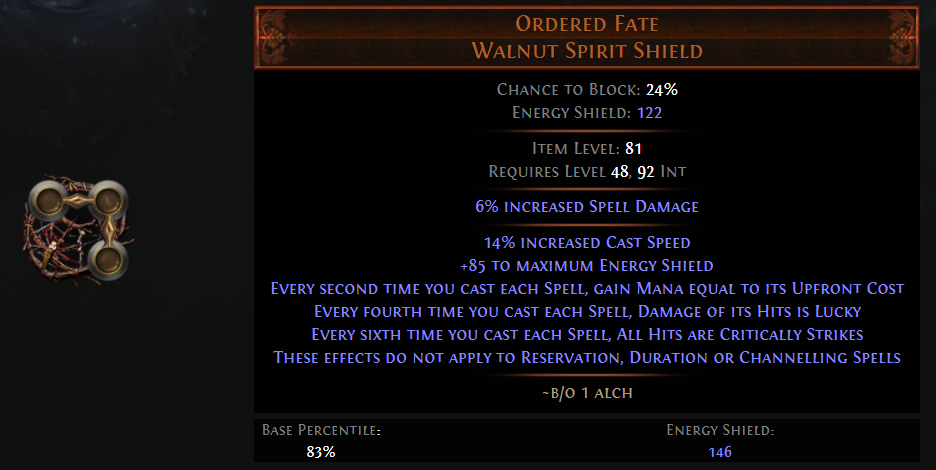
Ordered Fate is a level 48 unique Walnut Spirit Shield built around casting the same eligible spell repeatedly. Its bonuses arrive on a spell’s second, fourth, and sixth casts, rewarding a self-cast hit build that can make regular use of those milestones. The shield provides Spell Damage, Cast Speed, and Energy Shield, but its main value comes from coordinating casts with its effects.
Ordered Fate Stats
- Item type: Walnut Spirit Shield
- Requires: Level 48, 92 Intelligence
- Chance to Block: 24%
- Energy Shield: 134–177
- Movement Speed: -3%
- Spell Damage: 5–10% increased
- Cast Speed: 12–24% increased
- Energy Shield: +80–110 to maximum Energy Shield
- Every second time you cast each Spell, gain Mana equal to its Upfront Cost.
- Every fourth time you cast each Spell, Damage of its Hits is Lucky.
- Every sixth time you cast each Spell, All Hits are Critically Strikes.
- These effects do not apply to Reservation, Duration, or Channelling Spells.
- Upfront Costs are all costs that are not paid per second.
The shield’s displayed Energy Shield and other defensive values assume 20% quality, as listed in the item data.
How Ordered Fate Works
The milestones are tracked separately for each spell. Repeatedly casting your main spell builds toward its own second-, fourth-, and sixth-cast effects. Casting a different spell does not advance that spell’s sequence.
The second cast refunds Mana equal to that spell’s Upfront Cost. This can help with Mana sustain, especially if your main spell is costly, but it does not make every cast free: the refund occurs on every second cast, and other costs may still need to be managed.
On the fourth cast, the spell’s hit damage is Lucky. Lucky damage is useful for a hit-based spell because it improves the damage roll on that milestone cast. On the sixth cast, all hits from that cast are critical strikes. These effects give the spell a repeating six-cast cycle, but they do not turn every cast into a Lucky or critical hit.
Recommended Build Concept
Use Ordered Fate with a self-cast hit spell as your main damage skill. Choose a spell you are comfortable casting repeatedly and build around its ordinary damage, while treating the fourth- and sixth-cast bonuses as periodic boosts.
A straightforward approach is to:
- Use one eligible spell as your primary damage skill.
- Invest in the spell’s normal damage, critical strike chance, and critical strike multiplier.
- Build enough Mana sustain to handle casts between the shield’s refunds.
- Add defenses and recovery appropriate to your character and content.
- Use other skills for utility, while remembering that each spell has its own cast sequence.
The shield is less suited to builds whose main damage comes from Channelling or Duration spells, since Ordered Fate’s special effects do not apply to those spell types. It is also a poor match for a build that constantly switches between many damage spells and rarely reaches each spell’s fourth or sixth cast.
Upfront Cost: What to Budget For
There are two costs to consider: the Mana paid to cast your spell and the currency needed to put the build together.
Spell Upfront Cost: Ordered Fate defines this as a cost that is not paid per second. The every-second-cast effect returns Mana equal to the spell’s Upfront Cost. This can offset part of the cost over repeated casts, but you should still plan for the Mana needed before the refund occurs and for any other costs your setup has.
Build currency: The shield is the defining item, but it is only one part of the build. Your total investment depends on the main spell, your defensive gear, and how much damage and survivability you want. I can’t give a reliable 3.30 total in Divine Orbs from the available price data: listings vary by league and trade mode, and the current results I found did not establish a dependable price for the active trade league. Check current listings for your league before setting a budget.
For a lower-cost start, build around an affordable self-cast spell and use the shield’s cast milestones as bonuses. Add more expensive gear only when you can identify a clear upgrade to damage, Mana sustain, or defense.
Strengths and Limitations
Strengths
- Gives Spell Damage, Cast Speed, and maximum Energy Shield.
- Returns Mana on every second cast of each eligible spell.
- Provides Lucky hit damage and guaranteed critical strikes on specific casts in the cycle.
- Can support different eligible spells independently.
Limitations
- The strongest effects are periodic, rather than active on every cast.
- The sixth-cast critical strike bonus does not replace the need to make the rest of the spell’s casts effective.
- The effects exclude Reservation, Duration, and Channelling spells.
- Its 92 Intelligence requirement and movement speed penalty should be included in your gear planning.
How to Get Ordered Fate
Ordered Fate has restricted drop conditions and cannot be obtained by using an Orb of Chance. It drops from a boss empowered by a Fate that rewards the item in the Covens league. Before choosing a Fate, check that it offers Ordered Fate as a reward; simply empowering a boss does not guarantee this shield.
Is Ordered Fate Worth Building Around?
Ordered Fate is worth considering if you want to repeatedly self-cast one hit spell and enjoy planning around a repeating cast pattern. Its Mana return can help with sustain, while its fourth- and sixth-cast effects create predictable damage spikes.
The shield is less attractive if your main skill is excluded by its restrictions or if your build relies on rapid skill swapping. In those cases, its core effects may not contribute consistently enough to justify building around it.
About the Author