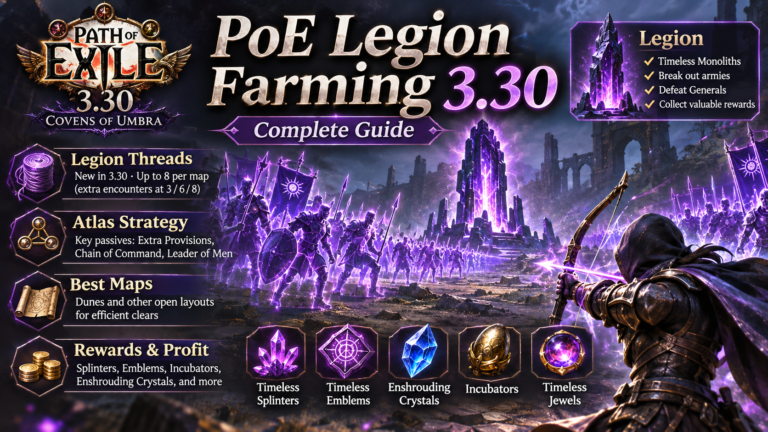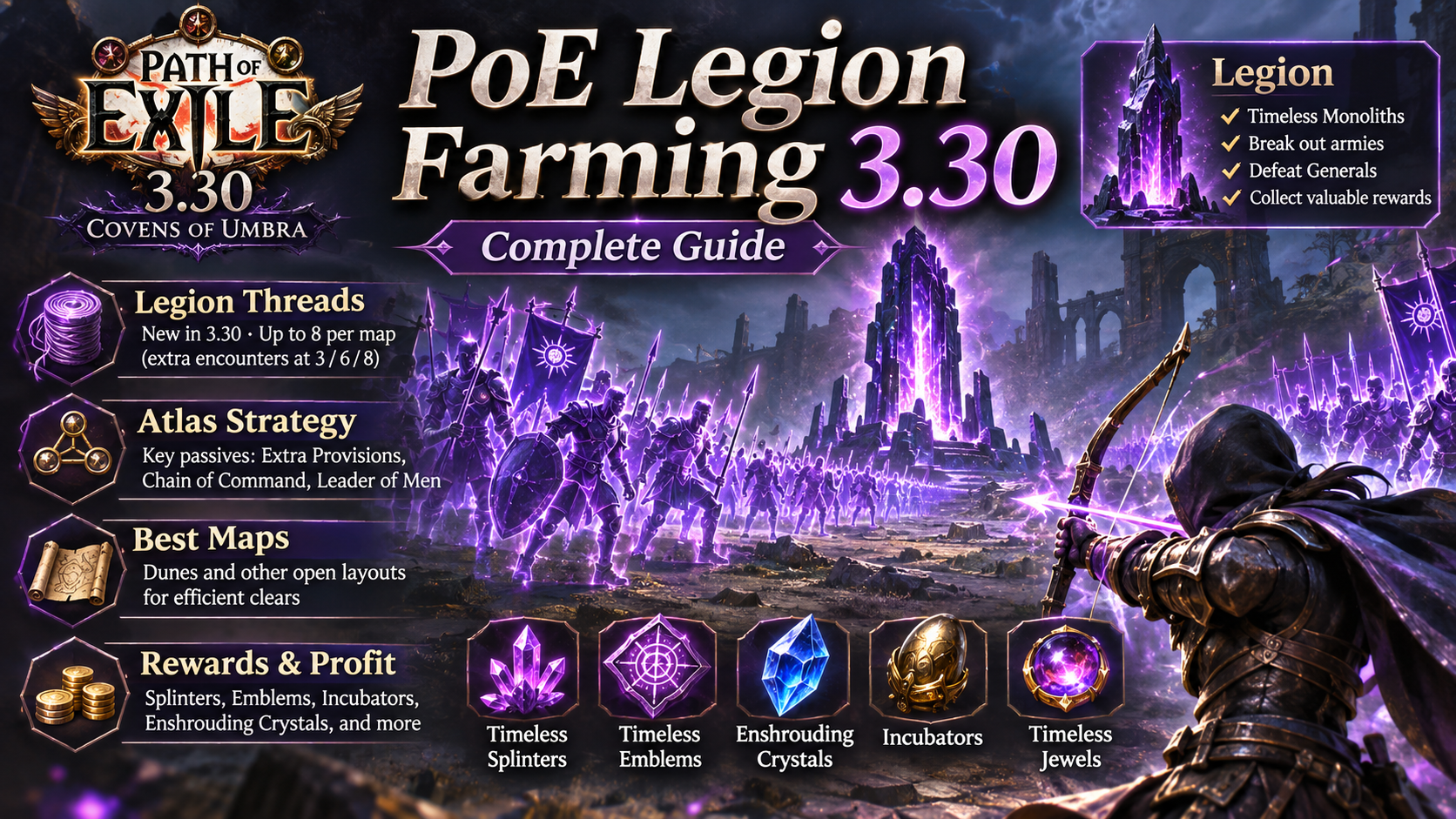
Legion farming remains an attractive endgame strategy in Path of Exile 3.30: Covens of Umbra, especially for players using builds with strong area damage, fast movement, and efficient monster clearing.
However, version 3.30 significantly changes how Legion encounters are added to maps, how they scale, and how players maximize their rewards. The traditional Scarab-based approach has been replaced by Threads of Creation, while the redesigned Atlas passive tree offers new ways to improve Legion encounters.
This guide explains how to farm Legion efficiently in PoE 3.30, including the best maps, Atlas passive priorities, Legion Thread setups, Timeless Splinters, Emblems, Enshrouding Crystals, and strategies for generating currency.
1. What Changed for Legion Farming in PoE 3.30?
The most important change is that Legion is now an opt-in map mechanic. Instead of relying on random encounters or Legion Scarabs, players primarily use Legion Threads or the corresponding Shaped Region to access the content.
|
Feature |
PoE 3.30 mechanics |
|---|---|
|
Legion Scarabs |
Replaced by Threads of Creation |
|
Legion encounters |
Added through Legion Threads or Shaped Regions |
|
Thread limit |
Normally up to 8 per map |
|
Atlas passive tree |
Reworked with new Legion-specific options |
|
Thread bonuses |
Additional encounters at 3, 6, and 8 Threads |
|
Legion rewards |
Splinters, Emblems, Incubators, Enshrouding Crystals, and other loot |
|
Atlas Drops |
Influences Legion reward drops |
|
Legion Schism |
Breaking out monsters and chests generates approximately 33% less Schism progress than before |
Patch 3.30.0c, released November 18, 2026, also introduced guaranteed additional Legion encounters at specific Thread investment levels and reduced the excessive difficulty scaling associated with Threads.
The biggest strategic change: Legion farming is now about balancing the number of Threads, encounter difficulty, Atlas investment, and map completion speed. Using the maximum number of Threads is not necessarily the most profitable approach for every build.
2. How to Start Legion Farming in PoE 3.30
Legion encounters revolve around Timeless Monoliths, which release two opposing armies trapped in stasis.
When you activate a Monolith, you must break out as many valuable monsters and chests as possible before the encounter progresses into combat.
Step-by-step Legion farming
- Prepare your map. Select a suitable map and apply Legion Threads through the Map Device, unless the map already receives them from a Shaped Region.
- Find the Timeless Monolith. Explore the map until you locate the Legion encounter.
- Activate the Monolith. Two armies appear, temporarily frozen in place.
- Break out valuable targets. Focus on reward-marked enemies, Sergeants, War Hoards, and Generals.
- Defeat the released enemies. Once combat begins, eliminate the Legion monsters as efficiently as possible.
- Collect the rewards. Prioritize valuable currency, Timeless Splinters, Emblems, Incubators, and other Legion-specific drops.
- Repeat across multiple maps. Track your results to determine which Thread investment produces the best returns.
The goal is not simply to defeat as many monsters as possible. It is to release and kill the enemies that offer the greatest expected rewards.
For more information about the encounter mechanics, see the PoE Wiki Legion guide .
3. Best Legion Thread Setup for Farming
In PoE 3.30, Legion Threads determine how heavily you invest in Legion encounters.
Each additional Thread increases the potential difficulty and rewards while improving the chance of powerful Legion-specific modifiers.
Legion Thread breakpoints
|
Legion Threads |
Guaranteed additional encounters |
Recommended use |
|---|---|---|
|
1–2 |
None from breakpoint bonus |
Low-investment farming |
|
3 |
+1 |
Beginner and budget farming |
|
4–5 |
+1 |
Moderate investment |
|
6 |
+2 |
Balanced Legion farming |
|
7 |
+2 |
Strong clearing builds |
|
8 |
+3 |
High-investment farming |
|
10 |
+3 from the 8-Thread breakpoint, with additional Thread scaling |
Specialized Unwavering Vision setups |
The additional encounter bonuses are cumulative breakpoint benefits, not separate bonuses to add together. For example, 8 Threads grant three additional encounters through the breakpoint system, not six.
Patch 3.30.0c also guarantees at least one random Thread modifier with 1–3 Threads, two with 4–7, and three with 8 or more.
Recommended setups
Budget farming: 3 Legion Threads
This is a practical starting point for characters with limited currency. It provides an extra encounter without requiring maximum Thread investment.
Balanced farming: 6 Legion Threads
For many established characters, six Threads are worth testing first. They provide two additional encounters and improve the chance of powerful modifiers without requiring the full eight-Thread cost.
High-investment farming: 8 Legion Threads
Eight Threads suit builds that can consistently break out and defeat large Legion armies. The additional encounters and modifier potential can generate considerable loot, but map completion times and Thread costs must be monitored.
Important Legion Thread modifiers
Legion Threads can introduce effects such as:
- Additional Legion encounters.
- Both opposing armies containing Generals.
- Legion chests becoming War Hoards.
- Higher-ranked monsters appearing closer to the Monolith.
- Lower-ranked enemies being upgraded.
- Crystals that produce rewards when nearby high-ranking monsters die.
- Monsters that can be released from stasis repeatedly, becoming more difficult and rewarding.
These modifiers can dramatically alter a map’s difficulty and potential returns.

4. Best Atlas Passive Tree for Legion Farming 3.30
The redesigned Atlas tree offers multiple ways to specialize in Legion.
Rather than allocating every available Legion passive without considering your build, focus on bonuses that improve encounter rewards, monster density, and your ability to complete encounters.
Recommended Legion Atlas passives
|
Atlas passive |
Main benefit |
Priority |
|---|---|---|
|
Extra Provisions |
Additional War Hoard and chest rewards |
High |
|
Chain of Command |
Four additional Legion Sergeants |
High |
|
Battle-Tested |
Reward-bearing monsters can gain more rewards but become tougher |
High for powerful builds |
|
Prolonged Struggle |
Longer Legion encounters and increased damage against monsters in stasis |
High for weaker clear builds |
|
Spoils of War |
Legion chests can transfer rewards to nearby released monsters |
High |
|
Leader of Men |
More Timeless Splinters from Generals and improved General availability |
High for Emblem farming |
|
Blood Feud |
Choose a Legion faction preference and improve corresponding Enshrouding Crystal opportunities |
Situational |
|
Timeless Conflict |
Replaces the standard encounter timer with a Schism-based release system |
Build-dependent |
These are 3.30 Atlas options; their value depends on the build and the desired reward category.
Recommended Atlas investment order
For general-purpose Legion currency farming, prioritize:
- Legion reward-bearing monsters and War Hoards.
- Additional Sergeants and encounter rewards.
- Enough stasis duration or damage to release valuable enemies reliably.
- General and faction-specific bonuses if targeting Splinters or Enshrouding Crystals.
- Map modifier effect, Atlas Drops, and supporting mechanics such as Shrines.
One important consideration is Battle-Tested. Although the passive increases rewards, it also increases monster life. A character that struggles to defeat upgraded Legion monsters may perform better without this passive until its damage improves.
Is Timeless Conflict worth taking?
Timeless Conflict changes how Legion encounters are released.
Instead of using the normal countdown, breaking out enemies and chests builds Schism until the encounter begins.
This can be useful for players who prefer a more controlled encounter. However, the 3.30 reduction in Schism generation changes the pacing.
Test it against the standard encounter system before committing to it for long-term farming.
5. Best Maps for Legion Farming 3.30
Map layout can matter nearly as much as Atlas investment.
Legion armies occupy substantial space, so open maps generally provide better opportunities to release large numbers of enemies.
|
Map |
Advantages |
Recommended use |
|---|---|---|
|
Dunes |
Wide, open terrain with few obstacles |
General Legion farming |
|
Jungle Valley |
Suitable clearing routes with room for large encounters |
Legion and Shrine farming |
|
Other open-layout maps |
Easier targeting and efficient movement |
Alternative map farming |
|
Narrow indoor maps |
Can restrict army placement and movement |
Usually less desirable |
Why Dunes is a strong choice
Dunes is particularly effective for high-speed Legion farming because its open terrain makes it easier to reach reward-bearing monsters before stasis ends.
It is also featured in current 3.30 farming strategies combining Legion, Abyss, and Bestiary.
However, these more advanced strategies may require significantly stronger characters than straightforward Legion farming.
Recommendation: Start with Dunes or another accessible open-layout map. Choose the highest map tier your character can clear efficiently rather than automatically running the most difficult map available.
6. Legion Rewards: What Should You Farm?
Legion provides several distinct reward categories.
Understanding which rewards are consistently valuable helps players determine whether to focus on ordinary mapping, General farming, or the Domain of Timeless Conflict.
Main Legion rewards
|
Reward |
How to obtain |
Farming value |
|---|---|---|
|
Timeless Splinters |
Legion monsters, chests, and Generals |
Combine into Emblems |
|
Timeless Emblems |
Combine Splinters or obtain through applicable rewards |
Sell or run Domain encounters |
|
Incubators |
Legion rewards |
Additional rewards through monster kills |
|
Timeless Jewels |
Legion-related endgame rewards |
Build-defining items |
|
Enshrouding Crystals |
Legion Generals |
Specialized unique-item crafting |
|
Currency items |
Legion enemies and reward symbols |
General farming income |
|
Other reward items |
Reward-bearing monsters and War Hoards |
Variable value depending on the market |
See the Legion league reward reference for additional details.
Timeless Splinters and Emblems
Legion contains five primary factions. Each has a corresponding Splinter and Emblem.
|
Legion faction |
Emblem |
Associated Timeless Jewel |
|---|---|---|
|
Eternal Empire |
Timeless Eternal Emblem |
Elegant Hubris |
|
Karui |
Timeless Karui Emblem |
Lethal Pride |
|
Maraketh |
Timeless Maraketh Emblem |
Brutal Restraint |
|
Templar |
Timeless Templar Emblem |
Militant Faith |
|
Vaal |
Timeless Vaal Emblem |
Glorious Vanity |
You can combine 100 Splinters of the same faction into one Emblem.
At least two different Emblems are needed to access the Domain of Timeless Conflict. Using five different Emblems creates the familiar five-faction encounter.
The value of individual Emblems depends on demand, supply, and the current league economy.
7. How to Farm Legion Generals and Enshrouding Crystals
Legion Generals are especially important for players targeting specialized Legion rewards.
In addition to faction-related loot, Generals can drop Enshrouding Crystals.
These crystals are used with unique items in the Legion enshrouding system.
Farming strategy
First, invest in Atlas passives that improve General availability. Then choose a faction through Blood Feud if you are targeting a particular crystal.
During each encounter, move toward the back of the Legion formation, where Generals can appear. Prioritize releasing the General before the encounter advances.
After the encounter, defeat the General and collect its rewards.
New Afarud reward in PoE 3.30
Version 3.30 added the Afarud Enshrouding Crystal, which can Enshroud Unique Quivers.
This crystal can drop from the Afarud General in Miraged Legion encounters.
It should not be confused with the ordinary five-faction Legion crystals or assumed to drop from every standard Legion encounter.
For players targeting this specific reward, Miraged Legion encounters are an important additional farming route.
8. Legion Farming vs. Domain of Timeless Conflict
There are two main ways to approach Legion as a currency-making activity.
Strategy A: Farm Legion encounters in maps
Focus on repeatedly clearing Legion encounters and selling valuable drops.
Advantages include relatively straightforward gameplay, easier map-to-map repetition, and consistent access to multiple reward categories.
This is generally the better starting strategy for players who do not yet have a specialized character.
Strategy B: Farm the Domain of Timeless Conflict
Collect or purchase Emblems and use them to access the Domain.
This strategy centers on defeating enemies and Generals within the Domain, generating rewards, and pursuing valuable Legion-specific drops.
It can be profitable, but its success depends on several factors, including the price of Emblems, the character’s damage, the number of enemies defeated, and the market value of the resulting loot.
Do not assume that running Emblems is automatically more profitable than selling them. Compare the cost of each Domain run with the realistic value of its rewards.
9. Best Builds for Legion Farming 3.30
Legion strongly rewards characters that can damage large areas and move quickly between targets.
An effective Legion build should have:
- High area-of-effect damage or reliable projectile chaining.
- Fast movement between enemy groups.
- Enough damage to release rare monsters and Generals.
- Sufficient defenses for increased Thread difficulty.
- Consistent performance against densely packed enemies.
Build archetypes to consider
|
Build archetype |
Legion strengths |
|---|---|
|
Lightning Arrow-style bow builds |
Wide projectile coverage and fast clearing |
|
Explosive Arrow builds |
Area damage and strong coverage with suitable setups |
|
Elemental spell builds |
Large-area damage with appropriate skill choices |
|
Minion builds |
Can handle Legion effectively when minion targeting and coverage are sufficient |
|
Melee builds |
Can work well with strong mobility, explosions, or large attack coverage |
These are general archetypes rather than a verified ranking of the strongest 3.30 builds.
For maximum Thread investment, monster damage and survivability become increasingly important.
A build that clears six-Thread Legion maps quickly may generate more currency per hour than the same build struggling through eight-Thread maps.
10. Advanced Legion Farming: Threads, Shrines, and Other Mechanics
Experienced players can increase the density and potential rewards of their maps by combining Legion with other mechanics.
Legion + Shrines
Shrines can provide temporary buffs that improve movement, damage, and clearing speed.
A practical approach is to clear the map, collect useful Shrine buffs, and then activate the Legion encounter while those buffs are active.
This is especially helpful for builds that need additional damage or speed to release high-value Legion targets.
Legion + Abyss + Bestiary
Another advanced strategy combines three monster-heavy mechanics:
- Legion supplies dense armies and reward-bearing monsters.
- Abyss creates additional encounters and rare enemies.
- Bestiary introduces valuable beasts and additional challenging monsters.
This combination increases map complexity and can be demanding on weaker characters.
Current 3.30 community farming setups include this combination in high-tier Dunes maps, but the strongest published examples involve substantial investment and specialized builds.
Using Unwavering Vision
The reworked Unwavering Vision Atlas keystone is another option for dedicated Legion farmers.
It restricts maps to one type of Thread, converts a portion of found Threads into Gold, and grants two additional Threads to maps where Threads are applied.
These bonus Threads can exceed the normal eight-Thread maximum.
That makes a 10-Thread Legion setup possible, although it sacrifices the ability to combine different Thread types in the same map.
This strategy is worth considering only when your character can handle the increased investment and difficulty efficiently.
11. Combining Legion Farming With Fates in 3.30
The Covens of Umbra league introduces another opportunity to generate rewards while mapping: Fates.
Fates are separate from Legion, but players can benefit from both systems within the same map.
After defeating coven enemies and disrupting their rituals, players can select Fates that empower the area’s boss.
These Fates increase boss difficulty while offering additional rewards. Empowered bosses can also drop Viscera, which are used in the Wickerman system.
The Fate rewards depend on the options selected and the resulting boss encounter.
Recommended combined farming approach
- Enter a map prepared for Legion.
- Clear Legion encounters and collect their rewards.
- Complete available Coven encounters.
- Select useful Fates based on the displayed rewards.
- Defeat the empowered map boss.
- Collect Fate-specific rewards and any Viscera obtained.
The main advantage is that a single map can produce income from multiple systems.
However, challenging Fate bosses can add significant time to a run. Players focused strictly on Legion income should compare whether the extra boss rewards justify the additional time.
For detailed mechanics and rewards, consult the PoE Wiki Fate guide .
12. How to Maximize Legion Farming Profit
A profitable Legion strategy is not determined by loot per map alone.
The more useful measurement is net profit per hour.
Net Profit = Total Reward Value − Map and Thread Costs
Net Profit per Hour = Net Profit ÷ Total Farming Hours
Example farming comparison
The following figures are hypothetical examples, not measured 3.30 drop rates or actual market prices.
|
Setup |
Maps per hour |
Net profit per map |
Net profit per hour |
|---|---|---|---|
|
3 Threads |
15 |
12 Chaos |
180 Chaos |
|
6 Threads |
12 |
20 Chaos |
240 Chaos |
|
8 Threads |
8 |
27 Chaos |
216 Chaos |
In this example, six Threads generate more income per hour despite producing less profit per individual map than eight Threads.
This demonstrates why efficient clearing matters.
Practical optimization tips
1. Use a strict loot filter. Reduce the time spent collecting low-value equipment and minor rewards.
2. Sell Emblems in bulk. Selling multiple Emblems together can reduce trading time.
3. Prioritize valuable reward symbols. Some Legion monsters offer more useful rewards than ordinary soldiers.
4. Increase Atlas Drops where practical. Version 3.30 allows Atlas Drops to influence the number of rewards from Legion monsters and chests with reward icons, making map preparation more relevant.
5. Keep Incubators active. Apply useful Incubators to eligible equipment so ordinary monster kills contribute to extra rewards.
6. Track farming results over multiple maps. A single unusually valuable drop can distort your perception of profitability.
7. Avoid expensive map modifiers your build cannot handle. Frequent deaths and incomplete Legion encounters reduce effective returns.
13. Common Legion Farming Mistakes
|
Mistake |
Why it hurts farming |
Better approach |
|---|---|---|
|
Using eight Threads too early |
Difficulty or cost exceeds the character’s capabilities |
Begin with three or six |
|
Choosing narrow maps |
Army placement and clearing become less convenient |
Prefer open layouts |
|
Ignoring Generals |
Misses valuable faction-specific opportunities |
Prioritize Generals when available |
|
Releasing only ordinary monsters |
Leaves potentially valuable reward targets behind |
Focus on icons, Sergeants, and War Hoards |
|
Picking up every item |
Excessive looting slows the farming cycle |
Improve the loot filter |
|
Copying old Scarab setups |
Scarabs were replaced in 3.30 |
Use current Threads and Atlas passives |
|
Ignoring total costs |
High gross loot does not guarantee profit |
Track net profit per hour |
14. Frequently Asked Questions
Is Legion farming worth it in PoE 3.30?
Yes, Legion is a viable farming strategy, particularly for fast-clearing builds. Its profitability depends on Thread costs, map selection, Atlas investment, and current reward prices.
How do you spawn Legion encounters in 3.30?
Apply Legion Threads through the Map Device or run appropriate maps affected by a Legion Shaped Region.
How many Legion Threads should I use?
Three Threads provide a useful low-investment starting point. Six Threads are worth testing for balanced farming, while eight Threads offer greater scaling for stronger builds.
What is the best map for Legion farming?
Dunes is a strong choice because of its open layout. Other maps with sufficient open space can also work well.
What is the best Legion reward to farm?
There is no universally best reward. Timeless Emblems, Enshrouding Crystals, currency drops, and other valuable items all contribute to farming income. Prices change throughout the league.
Can I still use Legion Scarabs in PoE 3.30?
No. Scarabs were removed and replaced by Threads of Creation in the 3.30 update.
Can Legion farming be combined with Fates?
Yes. Players can farm Legion encounters and then complete Coven content to empower the map boss for additional rewards.
About the Author