On this page
- 1. What Are the Different Currencies in AION 2?
- 2. Complete List of AION 2 Currencies
- 3. Kina: The Main Currency in AION 2
- 4. Quna: AION 2 Premium Currency Explained
- 5. Abyss Points: AION 2 PvP Currency
- 6. Shugo Coins and Nightmare Coins Explained
- 7. Seasonal, Daeva Pass, and Event Currencies
- 8. Other Currencies and Progression Resources
- 9. How to Farm AION 2 Currencies Efficiently
- 10. Which AION 2 Currencies Should You Prioritize?
- 11. Can You Trade, Exchange, or Transfer Currencies?
- 12. AION 2 Currency FAQs
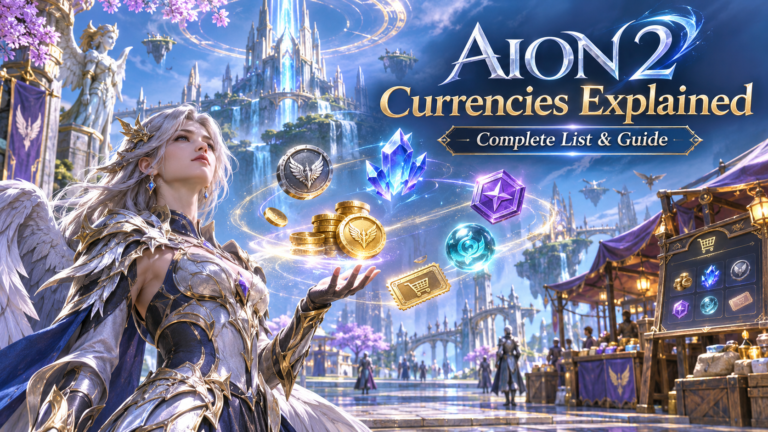
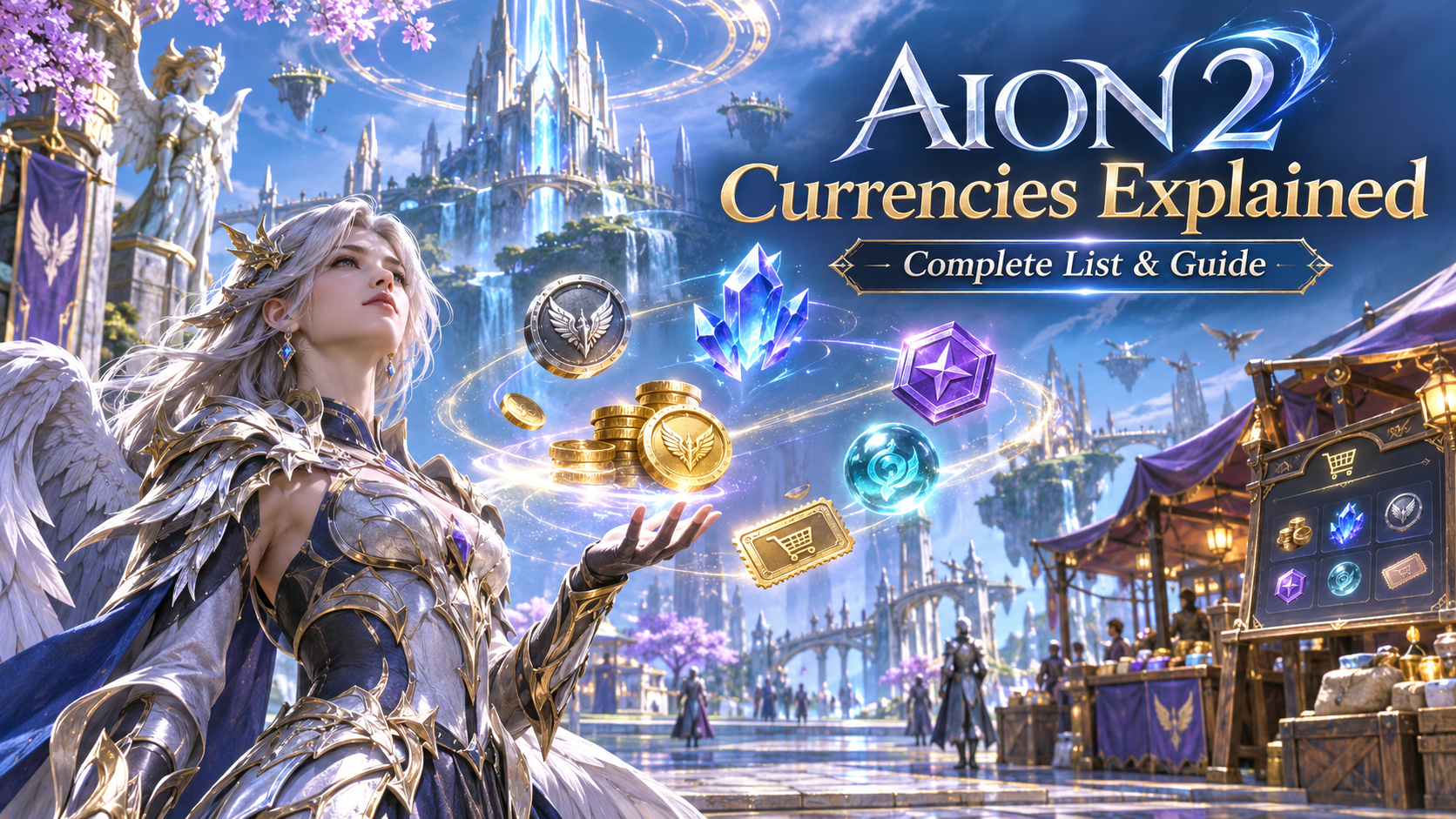
AION 2 features several currencies that players use for equipment upgrades, crafting, trading, PvP progression, premium purchases, and special event rewards. Understanding how these currencies work is essential if you want to develop your character efficiently without wasting valuable resources.
The main currency is Kina, which comes in Bound and Unbound forms. However, Kina is only one part of the game’s economy. Players will also encounter Quna, A2 Mileage, Abyss Points, Centuryroot Tokens, Phantasmal Fragments, Oath Coins, and Daeva Pass Shop Coins.
Some currencies are earned through everyday gameplay, while others are tied to specific dungeons, seasonal activities, shops, or premium products. Certain progression resources also appear in the currency interface, even though they cannot be used like ordinary money.
This guide explains the major AION 2 currencies, how to obtain them, where to spend them, and which ones you should prioritize. It focuses on the Global version, including North American and European servers, and reflects the information available as of November 4, 2026.
1. What Are the Different Currencies in AION 2?
AION 2 uses a multi-currency economy. Instead of paying for everything with one type of money, the game assigns different currencies to different activities and progression systems.
For example:
- Kina is the primary currency for everyday purchases, crafting, enhancement, and the player economy.
- Quna is the premium currency used for shop purchases and premium services.
- A2 Mileage is a separate reward balance associated with eligible purchases.
- Abyss Points are associated with PvP and Abyss progression.
- Centuryroot Tokens are used in the Shugo Festival Shop.
- Phantasmal Fragments are used in the Nightmare Shop.
- Oath Coins are used in the Season Shop.
- Daeva Pass Shop Coins are used for rewards in the Daeva Pass Shop.
The most important distinction is that these currencies generally cannot be exchanged freely.
For instance, having 100,000 Abyss Points does not mean you can convert them into 100,000 Kina. Each currency has its own purpose and usually requires you to visit its corresponding shop or progression interface.
The Main Categories of AION 2 Currencies
| Category | Main Currencies | Primary Purpose |
|---|---|---|
| General currency | Kina, Bound Kina | Everyday purchases and character progression |
| Premium currency | Quna | Premium shop and Daeva Pass |
| Loyalty currency | A2 Mileage | Mileage Shop rewards |
| PvP currency | Abyss Points, Medals of Merit | Abyss equipment and rewards |
| Activity currency | Centuryroot Tokens, Phantasmal Fragments | Shugo Festival and Nightmare rewards |
| Seasonal currency | Oath Coins | Season Shop purchases |
| Pass currency | Daeva Pass Shop Coins | Seasonal cosmetics and pets |
| Special progression resources | Enhance Stones, Daevanion Crystals, Soul Crystal Points | Character and equipment development |
Important: AION 2’s Global client also contains specialized currency entries that may not have fully documented acquisition methods or active shops. Some are progression-related resources rather than general-purpose money.
2. Complete List of AION 2 Currencies
The following table covers the major currencies and specialized currency entries found in the Global version.
| Currency | How to Obtain It | Where to Use It |
|---|---|---|
| Kina (Unbound) | Monsters, Conquest rewards, higher-level content, Market sales | Market, Kina Chests, Exchange |
| Bound Kina | Quests, achievements, Exploration rewards, NPC sales | Enhancements, crafting, NPC purchases |
| Quna | Real-money purchases, eligible Exchange transactions, occasional promotions | Premium Shop, Daeva Pass |
| A2 Mileage | Eligible shop purchases | Mileage Shop |
| Abyss Points | Abyss activities, PvP, quests, events, Supply Requests | Abyss Trade Shop |
| Centuryroot Token | Shugo Festival, achievements, event rewards | Festival Shop |
| Phantasmal Fragment | Nightmare rewards and special check-in rewards | Nightmare Shop |
| Oath Coin | Season Missions and seasonal rank rewards | Season Shop |
| Daeva Pass Shop Coin | Premium Daeva Pass rewards | Daeva Pass Shop |
| Silver Medal of Merit | Merit Chests and other progression rewards | Abyss Trade Shop |
| Gold Medal of Merit | Higher-grade Merit Chests and rewards | Abyss Trade Shop |
| Platinum Medal of Merit | Higher-grade Merit Chests and rewards | Abyss Trade Shop |
| Arena Token | Arena-related rewards | Arena Exchange Shop, when available |
| Legion Coin | Legion-related progression and rewards | Legion-related systems |
| Enhance Stone | Enhancement-related activities and conversions | Equipment enhancement |
| Soul Crystal Points | Pet Genus Insight Analysis | Soul Crystal progression |
| Daevanion Crystal | Daevanion-related progression and activities | Daevanion Boards |
| Daevanion Crystal: Ariel | Ariel-related progression | Ariel Daevanion Board |
| Daevanion Crystal: Azphel | Azphel-related progression | Azphel Daevanion Board |
| Daevanion Crystal: Marchutan | Marchutan-related progression | Marchutan Daevanion Board |
| Daevanion Crystal: Yustiel | Yustiel-related progression | Yustiel Daevanion Board |
The game also features temporary event currencies, such as Halloween Pumpkin Coins, and season- or chapter-specific variants of Oath Coins and Daeva Pass Shop Coins.
Not every entry in the database necessarily has an active acquisition method or shop in every patch. Arena Tokens and Legion Coins, for example, have specialized descriptions, but their current Global earning and spending details are less fully documented.
For practical purposes, most players should concentrate on Kina, Quna, Abyss Points, Centuryroot Tokens, Phantasmal Fragments, Oath Coins, and Daeva Pass Shop Coins first.
3. Kina: The Main Currency in AION 2
Kina is the primary in-game currency in AION 2. It is used throughout Atreia for everyday purchases and many important character progression activities.
You need Kina for:
- Equipment enhancement.
- Crafting and production.
- Substance Morph.
- Various NPC merchant purchases.
- Skill and progression-related expenses.
- Daevanion-related system costs.
- Market transactions and other player-economy activities.
Unlike some activity-specific currencies, Kina has a wide range of uses. This makes it one of the most important resources to collect throughout your character’s progression.
However, not all Kina works the same way.
AION 2 separates Kina into two main balances: Bound Kina and Unbound Kina.
Bound Kina vs. Unbound Kina
Understanding the difference between Bound and Unbound Kina is essential because they have different trading and storage restrictions.
| Feature | Bound Kina | Unbound Kina |
|---|---|---|
| General purchases | Yes | Yes |
| Equipment enhancement | Yes | Yes |
| Crafting | Yes | Yes |
| NPC purchases | Yes | Yes |
| Player Market | No | Yes |
| Quna Exchange | No | Yes, through the supported Exchange system |
| Transfer between players | No | Subject to official trading restrictions |
| Character progression | Yes | Yes |
| Storage restrictions | Cannot be freely transferred | Can use supported character and server storage systems |
Bound Kina
Bound Kina is currency that belongs to your character. You cannot freely transfer it to another player or use it for player-market transactions.
Common sources include:
- Main and regional quests.
- Achievements.
- Exploration dungeon rewards.
- Certain Daeva Pass rewards.
- Selling equipment and unwanted items to NPC merchants.
Bound Kina is useful for regular character progression, so earning it is still valuable even if you cannot trade it.
Unbound Kina
Unbound Kina is the more flexible form of currency.
It can be used for ordinary expenses and also supports transactions that require transferable Kina, including eligible Market purchases and Kina Chests.
Common sources include:
- Open-world monster drops.
- Higher-difficulty Expedition rewards.
- Conquest reward cubes.
- Transcendence rewards.
- Sanctuary and raid-related rewards.
- Selling eligible items through the Market.
One important detail: selling unwanted equipment to an ordinary NPC generally gives Bound Kina, not Unbound Kina. If an item has value to other players, check its Market price before selling it to an NPC.
What does Kina (All) mean?
You may also see Kina (All) in the game interface.
This is not a third type of currency. It represents the combined amount of Bound and Unbound Kina.
For expenses that accept both types, AION 2 generally spends Bound Kina first, followed by Unbound Kina.
For example:
Suppose you have:
- 50,000 Bound Kina.
- 100,000 Unbound Kina.
Your total Kina (All) is 150,000.
If you purchase an item costing 80,000 Kina and the cost accepts both types, the game uses your 50,000 Bound Kina first and takes the remaining 30,000 from your Unbound Kina.
This spending order is helpful because it allows you to preserve transferable Kina for transactions that specifically require it.
How to Farm Kina and Bound Kina
There are several ways to earn Kina in AION 2. The best method depends on your character level, equipment, available dungeon entries, and whether you need Bound or Unbound Kina.
1. Complete Quests and Achievements
Quests and achievements are useful sources of Bound Kina, especially during early progression.
Complete your main story quests, regional quests, and available achievement objectives instead of ignoring their currency rewards.
This is a reliable way for beginners to build their initial Kina balance without depending on difficult endgame content.
2. Sell Unwanted Equipment to NPC Merchants
Regular equipment and miscellaneous drops can be sold to NPC merchants.
This is a convenient way to clear your inventory while earning Bound Kina.
However, remember that NPC sales do not normally generate tradeable Unbound Kina.
Before selling rare or potentially valuable items, check whether other players are buying them through the Market.
3. Complete Expedition Conquest Dungeons
Expedition Conquest is an important source of Unbound Kina in the Global client.
Higher-difficulty reward cubes can provide substantially more transferable currency than ordinary Exploration rewards.
As your character becomes stronger, prioritize the highest Conquest difficulty you can clear consistently.
Do not select a difficulty simply because it offers better theoretical rewards. A reliable clear is usually more valuable than repeatedly failing difficult content.
4. Participate in Transcendence
Transcendence is another important activity for character progression and Kina acquisition.
Complete the stages available to your character and pay attention to the currency rewards in the reward interface.
Higher stages can provide better rewards, so improving your equipment and clearing efficiency can increase the value of your available attempts.
5. Complete Sanctuary and Raid Content
Endgame content can provide valuable reward cubes, including Unbound Kina.
For players who have reached the required progression level, Sanctuary and raid activities should become part of their regular farming routine.
The November 4 update also introduced Abyssal Forge: Ludra, giving eligible endgame players another major activity to pursue.
6. Sell Tradeable Items Through the Market
If you obtain valuable materials, equipment, or other tradeable items, compare their Market prices before selling them.
A player may be willing to pay considerably more than an NPC merchant for a material needed for crafting or equipment progression.
Check recent prices, item demand, and listing restrictions before deciding whether to sell.
Practical Kina Farming Advice
- Use Bound Kina for regular expenses whenever possible.
- Save Unbound Kina for Market purchases and other transactions that require it.
- Prioritize reward cubes that offer Unbound Kina.
- Do not sell potentially valuable tradeable materials to NPCs without checking their Market value.
- Plan your dungeon entries around available Odyle Energy.
- Check current reward and acquisition limits instead of relying on outdated farming numbers.
Some third-party EU/NA client-data guides report a daily Unbound Kina acquisition restriction. However, players should verify the current limit and reset behavior in their own client rather than treating figures from another region or earlier build as universal.
4. Quna: AION 2 Premium Currency Explained
Quna is AION 2’s premium currency.
Unlike ordinary Kina, Quna is primarily associated with premium products and services. It is used in the in-game Shop and at special Shugo Merchants.
Common Quna purchases include:
- Premium Daeva Pass.
- Character appearance services.
- Cosmetics and skins.
- Special consumables.
- Storage and inventory-related products.
- Other premium shop offerings.
Quna is especially important for players who want access to premium shop content or the paid Daeva Pass track.
How to Get Quna
There are several ways to obtain Quna.
1. Purchase Quna With Real Money
The most straightforward method is purchasing Quna through the in-game Shop.
The Global store has offered several Quna package sizes, including:
| Package | Quna |
|---|---|
| Small package | 400 |
| Second package | 1,000 |
| Third package | 2,000 |
| Large package | 4,000 |
Prices can vary depending on the platform and regional store, so check the current checkout screen before purchasing.
2. Exchange Unbound Kina for Quna
AION 2 also connects its gameplay economy with its premium currency system through the Quna Exchange.
Players can use eligible Unbound Kina transactions to obtain Quna through the supported Exchange system.
This provides a way for players who earn substantial amounts of Unbound Kina to participate in the premium economy without directly purchasing every Quna unit.
However, Exchange access requires an active Special Quai Membership.
3. Participate in Official Community Events
NC sometimes distributes Quna through special promotional activities and community competitions.
For example, the November 2026 Ludra Outfit Contest includes Quna rewards for selected participants.
These opportunities are occasional rather than a reliable farming method.
Paid, Pending, and Complimentary Quna
Depending on the transaction and wallet interface, players may encounter different Quna balance categories:
- Paid Quna: Quna obtained through purchases.
- Pending Quna: Quna subject to a waiting period before becoming available as Paid Quna.
- Complimentary Quna: Promotional or complimentary Quna tracked separately from Paid Quna.
Some current Global currency guides describe a 72-hour waiting period for Pending Quna to become Paid Quna. Check the balance details and transaction conditions in your own client before using Quna for an Exchange transaction.
How the Kina–Quna Exchange Works
The Quna Exchange connects players who want to exchange the value of their Unbound Kina and Quna.
Unlike an ordinary NPC shop, it operates through player-driven transactions.
The basic process is:
- Obtain Unbound Kina through gameplay.
- Make sure you have an active Special Quai Membership.
- Open the Quna Exchange interface.
- Check the available listings and current exchange prices.
- Place an eligible listing or purchase.
- Confirm the transaction and collect the resulting currency.
In the Global client, Kina Chests are an important part of the supported Kina Exchange process.
The exchange rate is influenced by player supply and demand rather than a permanently fixed NPC conversion rate.
For this reason, check the current listings before committing a large amount of Kina or Quna.
Important: Bound Kina cannot be used as a substitute for Unbound Kina in the Exchange.
5. Abyss Points: AION 2 PvP Currency
Abyss Points are a major currency associated with the Abyss and faction warfare.
They are important for players who want to participate in PvP and obtain equipment or other rewards from the Abyss Trade Shop.
Unlike Kina, Abyss Points are not a universal currency. Their main purpose is to support the game’s PvP-related progression systems.
How to Obtain Abyss Points
You can earn Abyss Points through several activities:
- Fighting enemy players in the Abyss.
- Participating in Abyss-related PvP activities.
- Completing certain quests and Season Missions.
- Participating in eligible events.
- Completing Supply Requests.
- Taking part in specific field activities and dungeon-related reward systems.
- Claiming special event and attendance rewards.
You do not necessarily have to spend all your time fighting other players to build an Abyss Point balance.
Some PvE and event activities also provide Abyss Points.
What Can You Buy With Abyss Points?
The Abyss Trade Shop offers various PvP-related rewards.
Depending on the available shop inventory and requirements, these can include:
- Abyss equipment.
- Equipment progression materials.
- Enhancement-related items.
- Consumables.
- Appearance rewards.
- Other special items.
Some equipment purchases may require both Abyss Points and Medals of Merit.
Therefore, do not assume that accumulating enough Abyss Points alone will automatically unlock every item.
Important Abyss Point Changes in the November 4 Update
The November 4, 2026 Global update introduced Chaotic Outer Reshanta.
Important details include:
- Entry is available starting at Level 45.
- Players receive three hours of base playtime per week.
- Outer Entry Stones can extend available playtime.
- Character stats, skill levels, and Stigma levels are standardized inside the area.
- The activity provides Abyss Points and Bound Kina among its rewards.
- Abyss Points earned through PvP in Chaotic Outer Reshanta are reduced by 50%.
The update also changed the Artifact Siege schedule from three times per week to twice per week, on Thursdays and Saturdays.
To compensate for the reduced frequency, Abyss Points awarded per Abyss Corridor run were increased by 50%.
If Abyss Points are important to your progression, adjust your weekly routine to account for these changes.
6. Shugo Coins and Nightmare Coins Explained
AION 2 has several activity-specific currencies. Two important examples are Centuryroot Tokens and Phantasmal Fragments.
These currencies are valuable because they allow players to purchase rewards from dedicated activity shops.
Centuryroot Token (Shugo Coin)
Centuryroot Tokens, commonly called Shugo Coins, are the currency associated with the Shugo Festival.
The Shugo Festival features different minigames and activities, including racing, jumping, memory challenges, and combat-oriented games.
How to Obtain Shugo Coins
You can obtain Centuryroot Tokens through:
- Participating in Shugo Festival minigames.
- Claiming festival reward selections.
- Completing Shugo Festival achievements.
- Certain Dimensional Invasion rewards.
- Special attendance and event rewards.
The festival is available after reaching Level 10 and completing the required introductory faction quest.
Activities become available at the beginning of each hour, with a short entry window.
Participation rewards include:
| Character Level | Participation Reward |
|---|---|
| Level 10–44 | 40 Centuryroot Tokens |
| Level 45 | 50 Centuryroot Tokens |
Additional tokens can be obtained through reward selections and achievements.
What Can You Buy With Shugo Coins?
Centuryroot Tokens are spent in the Shugo Festival Shop.
The available rewards include:
- Daevanion Crystals.
- Soul Crystals.
- Stigma Shards.
- Growth materials.
- Pets.
- Wings.
- Character appearance items.
- Artworks for Pantheon progression.
For players who want to improve their characters, growth materials can be a useful priority before purchasing purely cosmetic rewards.
Shugo Coins vs. Shugo Festival Reward Keys
These are two different things.
Centuryroot Tokens are the currency used in the Festival Shop.
Shugo Festival Reward Keys are used to claim additional reward selections after participating in festival games.
Do not confuse the two when planning your rewards.
Reward Keys are shared across characters on the same server, and their accumulation has a limit. Use them regularly rather than allowing your balance to reach the cap.
Phantasmal Fragment (Nightmare Coin)
Phantasmal Fragments are associated with the Nightmare activity.
Nightmare is a boss-focused dungeon system in which players challenge powerful enemies and earn rewards according to their performance and progression.
How to Obtain Nightmare Coins
The main sources include:
- Completing Nightmare dungeon challenges.
- Claiming eligible attendance rewards.
- Participating in special events that distribute Phantasmal Fragments.
The November 2026 Ludra Conquest Check-In provides 3,000 Phantasmal Fragments on Day 3.
This is a useful example of how special events can provide a substantial amount of an activity-specific currency without requiring players to farm the corresponding activity repeatedly.
What Can You Buy With Phantasmal Fragments?
Phantasmal Fragments are spent in the Nightmare Shop.
The Global client database lists a dedicated Trade Shop for this currency.
Available rewards are tied to the Nightmare progression system, and the exact shop inventory should be checked in the current game client.
For efficient farming:
- Check your available Nightmare entries or tickets.
- Select the highest stage your character can reliably clear.
- Complete the challenge.
- Collect the Phantasmal Fragment rewards.
- Open the Nightmare Shop.
- Compare available rewards with your character’s current equipment and progression needs.
Do not assume that every Nightmare ticket limit or stage rule published for the Korean or Taiwanese service applies identically to Global.
7. Seasonal, Daeva Pass, and Event Currencies
AION 2 also uses currencies associated with seasonal progression and limited-time events.
These currencies are particularly important because some of them have expiration dates or can only be used during a particular season.
Oath Coin
Oath Coin is the primary currency of the Season Shop.
You can obtain it through:
- Season Missions.
- Seasonal game-mode rank rewards.
- Other eligible seasonal progression rewards.
The Season Shop contains a variety of items, including:
- Growth materials.
- Enhancement-related resources.
- Consumables.
- Hidden Cube keys.
- Pet-related rewards.
- Wings and skins.
- Other special progression items.
Important: Oath Coins are season- or chapter-specific.
For example, Oath Coin: Season 2 and Oath Coin: Chapter 1 are separate currency variants. You should not assume that coins from one season can be used in another season’s shop.
My recommendation is to check the Season Shop regularly and prioritize valuable limited-stock progression items before the season ends.
Daeva Pass Shop Coin
Daeva Pass Shop Coins are associated with the premium Daeva Pass.
The basic Daeva Pass track is free, while the premium track requires Quna.
The Season 1 premium Daeva Pass costs 1,500 Quna, and its rewards include Daeva Pass Shop Coins at specific progression levels.
You can use these coins in the dedicated Daeva Pass Shop to purchase seasonal rewards.
Typical offerings include:
- Character skins.
- Weapon appearances.
- Accessories.
- Special cosmetics.
- Pets.
Daeva Pass Shop Coin vs. Quna
These currencies have different functions.
Quna is used to purchase the premium Daeva Pass.
Daeva Pass Shop Coins are earned from the premium reward track and spent in the Pass Shop.
Buying Quna does not mean you automatically receive all the rewards available in the Daeva Pass Shop. You must progress through the corresponding pass and claim its rewards.
Season 1 Expiration
For the current Global Season 1 Daeva Pass, the Pass Shop Coin and Pass Shop are scheduled to remain usable until the December 15, 2026 maintenance (PST).
Make sure to spend your remaining coins before that deadline.
Event-Specific Currencies
AION 2 also introduces temporary currencies for special events.
One example is the Halloween Pumpkin Coin.
Players could obtain these coins through the Trick or Treat attendance log and weekly event missions, then exchange them at the Halloween Coin Merchant for limited rewards.
The event ended with the November 4, 2026 maintenance, and its remaining Pumpkin Coins were scheduled for removal.
This illustrates an important rule:
Do not assume that every event currency can be saved indefinitely.
Before an event ends:
- Check the event’s expiration date.
- Visit its dedicated merchant.
- Review the remaining purchase limits.
- Spend the currency on rewards you actually need.
- Check whether unused coins or items will be deleted.
8. Other Currencies and Progression Resources
Besides the main currencies, AION 2 has several specialized resources that support particular character development systems.
Some appear in the currency interface or game database, but they do not function like Kina or Quna.
Arena Token
Arena Tokens are described as a currency earned through Arena activities and intended for the Arena Exchange Shop.
They are associated with competitive Arena progression.
However, the current Global client data does not fully document their active acquisition sources and shop inventory.
Check the Arena interface in your version before planning a farming route around them.
Legion Coin
Legion Coin is a Legion-related currency described as a reward for players who contribute to their Legion.
Its exact acquisition and spending mechanics are less fully documented in the current Global client data.
Do not confuse Legion Coins with Kina costs or ordinary Legion-related progression expenses.
Medals of Merit
Medals of Merit are important for certain Abyss equipment purchases.
The game includes several grades:
- Silver Medal of Merit.
- Gold Medal of Merit.
- Platinum Medal of Merit.
These medals can be obtained from eligible Merit Chests and other progression rewards.
They are used alongside Abyss Points for specific items in the Abyss Trade Shop.
For example, a reward chest from a major boss encounter may contain Abyss Points and a Medal of Merit.
If you are working toward specific Abyss equipment, check both the currency cost and the required medal grade before spending your points.
Enhance Stone
Enhance Stones are resources used for equipment enhancement.
They should be considered progression materials rather than general-purpose currency.
You cannot use them as a substitute for Kina when purchasing ordinary goods.
Instead, they support equipment improvement and other enhancement-related systems.
Daevanion Crystals
Daevanion Crystals are specialized resources connected to the Daevanion Board system.
The Global client lists several variants:
- Daevanion Crystal.
- Daevanion Crystal: Ariel.
- Daevanion Crystal: Azphel.
- Daevanion Crystal: Marchutan.
- Daevanion Crystal: Yustiel.
These resources are associated with their respective Daevanion progression systems.
Not every listed variant necessarily has an active board or acquisition route in every patch. Check the available Daevanion Boards and their requirements before farming a particular crystal.
Soul Crystal Points
Soul Crystal Points are obtained through Pet Genus Insight Analysis.
They are associated with the Soul Crystal progression system rather than ordinary shopping.
Do not confuse Soul Crystal Points with the Soul Crystal items that can be purchased from certain activity shops.
Silentium: A Currency-Like Resource
Silentium deserves a separate mention because it can function like a resource that converts into other progression value.
It is a special material rather than a general wallet currency.
Depending on the available Supply Requests, you can submit Silentium in exchange for Abyss Points or sell it to NPC merchants for Bound Kina.
This makes it potentially useful even if you primarily focus on PvE content.
Before selling Silentium to an NPC, compare the value of the Bound Kina with the Abyss Points available through Supply Requests.
9. How to Farm AION 2 Currencies Efficiently
The best approach to currency farming is not to spend all your time repeating one activity.
Instead, organize your routine around the currencies you need and the activities that reward them.
Here is a practical approach.
Step 1: Identify Your Current Progression Goal
First, decide what you are trying to obtain.
For example:
| Your Goal | Currency to Prioritize |
|---|---|
| General equipment upgrades | Kina, Bound Kina, Enhance Stones |
| Buying equipment from players | Unbound Kina |
| Premium shop purchases | Quna |
| PvP equipment | Abyss Points and Medals of Merit |
| Festival rewards | Centuryroot Tokens |
| Nightmare rewards | Phantasmal Fragments |
| Seasonal progression | Oath Coins |
| Daeva Pass cosmetics | Daeva Pass Shop Coins |
| Daevanion progression | Daevanion Crystals |
This prevents you from spending time farming currencies that do not contribute to your immediate goal.
Step 2: Complete Daily Activities
Daily activities are an important foundation for consistent progression.
Prioritize the activities that provide:
- Kina rewards.
- Dungeon reward opportunities.
- Nightmare entries or tickets.
- Special attendance rewards.
- Other progression materials.
Daily rewards can add up over time, especially when you combine them with weekly activities.
Step 3: Complete Weekly Season Missions
Season Missions are important for Oath Coin acquisition.
Check the Season interface and identify the missions you can complete naturally through your regular gameplay.
For example, combine dungeon clears, Abyss participation, and other available objectives instead of completing each mission through a separate farming session.
Remember that weekly rewards may be lost if you ignore the reset schedule.
Step 4: Participate in Shugo Festival
If you want Centuryroot Tokens, make the Shugo Festival part of your regular routine.
The activities rotate hourly, and you can choose the minigame that best matches your strengths.
Practical tips:
- Watch for the Shugo Festival notification.
- Enter during the available registration window.
- Choose an activity you can complete consistently.
- Claim your participation rewards.
- Use reward keys before reaching their accumulation cap.
- Spend Centuryroot Tokens on useful Festival Shop rewards.
You do not need to win every game to make participation worthwhile.
Step 5: Complete Nightmare Challenges
For Phantasmal Fragments, use your available Nightmare opportunities.
Try to clear the highest stage that your current equipment and build can handle reliably.
If you cannot complete a higher stage consistently, it may be more efficient to complete a lower stage rather than repeatedly wasting attempts.
Also check attendance rewards and special events, because they may provide additional fragments.
Step 6: Optimize Kina Farming
For Kina, focus on activities that provide the type of currency you actually need.
- Use Exploration rewards and quests to build Bound Kina.
- Complete Conquest content for eligible Unbound Kina rewards.
- Progress through Transcendence and Sanctuary as your equipment improves.
- Sell valuable tradeable items through the Market.
- Use NPC merchants to convert unwanted equipment into Bound Kina.
The most important habit is checking whether a reward gives Bound or Unbound Kina before deciding whether an activity is worthwhile.
Step 7: Monitor Special Events
Special events can provide substantial rewards with relatively little additional farming.
The November 2026 Ludra Conquest Check-In is a good example.
Its seven reward milestones include:
| Check-In Day | Reward |
|---|---|
| Day 1 | 500,000 Bound Kina |
| Day 2 | 2,000 Centuryroot Tokens |
| Day 3 | 3,000 Phantasmal Fragments |
| Day 4 | 30,000 Abyss Points |
| Day 5 | 3,000 Soul Crystals |
| Day 6 | 1,000,000 Bound Kina |
| Day 7 | Special helmet reward |
The event runs from November 4 to November 17, 2026 (PST), with corresponding regional dates.
Logging in regularly allows you to claim these rewards without having to farm every currency individually.
10. Which AION 2 Currencies Should You Prioritize?
Not every currency deserves the same priority.
Your priorities should depend on your character level, equipment, playstyle, and long-term objectives.
For Beginners
New players should concentrate on:
- Bound Kina.
- Unbound Kina.
- Basic equipment enhancement resources.
- Centuryroot Tokens.
- Available event rewards.
Kina supports many everyday expenses, while Shugo Festival rewards can provide useful progression materials.
Avoid spending premium currency on unnecessary items before understanding the game’s economy.
For PvE Players
Players who mainly enjoy dungeons, raids, and character progression should focus on:
- Kina.
- Enhance Stones.
- Phantasmal Fragments.
- Oath Coins.
- Centuryroot Tokens.
- Daevanion Crystals.
These resources support equipment development, dungeon-related rewards, and seasonal progression.
For PvP Players
If your main objective is PvP, prioritize:
- Abyss Points.
- Silver, Gold, and Platinum Medals of Merit.
- Kina for enhancement.
- Other materials required by your desired Abyss equipment.
Keep track of weekly activities and the updated Artifact Siege schedule.
The November 4 changes make it particularly important to plan your Abyss activities rather than relying on the previous three-siege weekly schedule.
For Free-to-Play Players
Free-to-play players should focus on currencies and resources that can be earned through regular gameplay.
Good priorities include:
- Bound and Unbound Kina.
- Abyss Points.
- Centuryroot Tokens.
- Phantasmal Fragments.
- Oath Coins.
- Enhancement materials.
Quna can also be obtained through eligible Exchange transactions, but using that route requires the paid Special Quai Membership.
Therefore, distinguish between currencies that are earnable through gameplay and systems that require a paid access feature.
For Players Interested in Cosmetics
If your main goal is character appearance, pets, and other cosmetic rewards, pay attention to:
- Quna.
- A2 Mileage.
- Daeva Pass Shop Coins.
- Centuryroot Tokens.
- Oath Coins.
Different shops offer different cosmetic collections, so compare their available rewards before spending.
11. Can You Trade, Exchange, or Transfer Currencies?
This is one of the most important questions for players managing multiple characters or participating in the player economy.
The short answer is that some currencies support limited exchange or storage systems, but most activity-specific currencies cannot be freely transferred.
Can You Trade Bound Kina?
No.
Bound Kina belongs to your character and cannot be freely transferred to another player.
It is intended for personal character progression and ordinary purchases.
Can You Trade Unbound Kina?
Unbound Kina supports the official Market and Quna Exchange systems.
However, the Global version has disabled direct player-to-player trading as an anti-bot measure.
The Market and supported Exchange systems are therefore the important official channels for player-economy transactions.
Can You Exchange Kina for Quna?
Yes, through the Quna Exchange, subject to its access requirements.
An active Special Quai Membership is required.
The exchange is player-driven, so prices depend on supply and demand.
It is not the same as converting Bound Kina through an NPC merchant.
Can You Exchange Other Currencies?
Most activity-specific currencies are restricted to their own shops.
For example:
| Currency | Exchange Into Kina? | Main Spending Destination |
|---|---|---|
| Bound Kina | No | General purchases |
| Unbound Kina | Through supported Exchange systems | Market and Kina-related transactions |
| Quna | Through supported Exchange systems | Premium Shop |
| Abyss Points | No general conversion | Abyss Trade Shop |
| Centuryroot Tokens | No general conversion | Festival Shop |
| Phantasmal Fragments | No general conversion | Nightmare Shop |
| Oath Coins | No general conversion | Season Shop |
| Daeva Pass Shop Coins | No general conversion | Daeva Pass Shop |
| A2 Mileage | No general conversion | Mileage Shop |
Some materials can be converted through Supply Requests or Substance Morph. These are specific item-conversion mechanics, not unrestricted exchanges between currency balances.
Can You Transfer Currency Between Characters?
AION 2 has different storage and transfer rules depending on the currency.
For example:
- Bound Kina remains character-bound.
- Unbound Kina can use supported storage systems.
- Kina stored in character inventory and Character Storage is included in the documented server-transfer rules.
- Kina in Server Storage does not move with a character during a server transfer.
- Quna and A2 Mileage move with the server-transfer process and are added to the destination server’s existing balances.
- Daeva Pass Shop Coins are awarded to the character associated with the premium pass.
Before transferring a character, check the official transfer requirements and make sure no Market transactions, unclaimed shop items, or other outstanding items are preventing the transfer.
12. AION 2 Currency FAQs
What is the main currency in AION 2?
Kina is the main currency. It is used for everyday purchases, crafting, equipment enhancement, and other character progression activities.
It has two primary forms: Bound Kina and Unbound Kina.
What is the difference between Bound Kina and Unbound Kina?
Bound Kina is restricted to your character and cannot be freely traded.
Unbound Kina supports eligible player-economy transactions, including Market purchases and the Quna Exchange.
For costs that accept both types, Bound Kina is generally spent first.
What is Quna used for in AION 2?
Quna is the premium currency.
It is used for premium shop purchases, the premium Daeva Pass, special services, and other products available through the in-game shop.
Can you get Quna for free?
There are limited ways to obtain Quna without directly purchasing it.
Players can obtain Quna through eligible Kina Exchange transactions, which require a Special Quai Membership. Official community promotions and contests may also offer Quna as rewards.
However, ordinary gameplay does not provide a general unlimited Quna farming method.
How do you farm Kina quickly in AION 2?
Focus on the highest-value activities your character can complete consistently.
Important options include Conquest reward cubes, Transcendence, Sanctuary, eligible Market sales, and ordinary monster farming.
Also complete quests and Exploration content to build Bound Kina.
What are Shugo Coins used for?
Shugo Coins, officially called Centuryroot Tokens, are used in the Shugo Festival Shop.
You can exchange them for growth materials, cosmetics, pets, wings, and other rewards.
What are Nightmare Coins in AION 2?
Nightmare Coins are another name for Phantasmal Fragments.
They are associated with Nightmare dungeon rewards and are spent in the Nightmare Shop.
What are Oath Coins used for?
Oath Coins are the currency used in the Season Shop.
You obtain them through Season Missions and seasonal rank rewards.
Different seasons and chapters can use different Oath Coin variants.
Are Daeva Pass Shop Coins the same as Quna?
No.
Quna is the premium currency used to purchase the premium Daeva Pass.
Daeva Pass Shop Coins are rewards from the premium pass track and are used to purchase items in the dedicated Pass Shop.
Can you convert Abyss Points into Kina?
There is no general direct conversion between Abyss Points and Kina.
Abyss Points are primarily used for Abyss-related purchases and progression.
Do AION 2 currencies expire?
Some currencies and rewards are permanent, while others are seasonal or event-specific.
For example, the Global Season 1 Daeva Pass Shop Coins are scheduled to expire with the December 15, 2026 maintenance.
Halloween Pumpkin Coins were also removed after the November 2026 Halloween event.
Always check the expiration information displayed in the relevant event or shop interface.
How many currencies are there in AION 2?
The Global client data index identifies 17 core currency entries outside the separately tracked premium Quna balance.
The practical total can be higher when you count A2 Mileage, seasonal variants, special medals, temporary event currencies, and progression-specific resources.
The exact count therefore depends on what you classify as a currency.
Which currencies should I save in AION 2?
Prioritize currencies based on your progression goals.
Kina is essential for general development, Abyss Points are important for PvP progression, and activity-specific tokens should be saved for rewards you actually need.
Always spend temporary event currencies before their expiration dates.
About the Author