On this page
- Aion 2 PvP Class Tier List
- Which Class Is Currently Ranked S-Tier for 1v1 Arena PvP in Aion 2?
- How Does the Gladiator Class Maintain Its High Win Rate and Dominance in Melee PvP?
- Is the Assassin Class Top-Tier for PvP, or Does It Require Too Much Gear and Skill to Work?
- Why Are Chanter Hybrid Supports Performing So Strongly in Early Global Patch Metas?
- Which Healing and Support Class Is Better for Group and Abyss PvP: Cleric or Chanter?
- How Do High-Level Stigma Skills and Item Score Requirements Shift a Class Up or Down the Tier List?
- Which Ranged Damage Dealer—Sorcerer, Ranger, or Spiritmaster—Dominates Ranged PvP Combat?
- What Makes the Templar an Essential S-Tier Pick for Abyss Sieges and Objective Control?
- How Much Did Recent Balance Updates and PvP Damage Nerfs Change the Overall Class Hierarchy?
- Which Class Is the Best and Most Forgiving Choice for Beginners Starting Out in Competitive PvP?
Aion 2 PvP Class Tier List
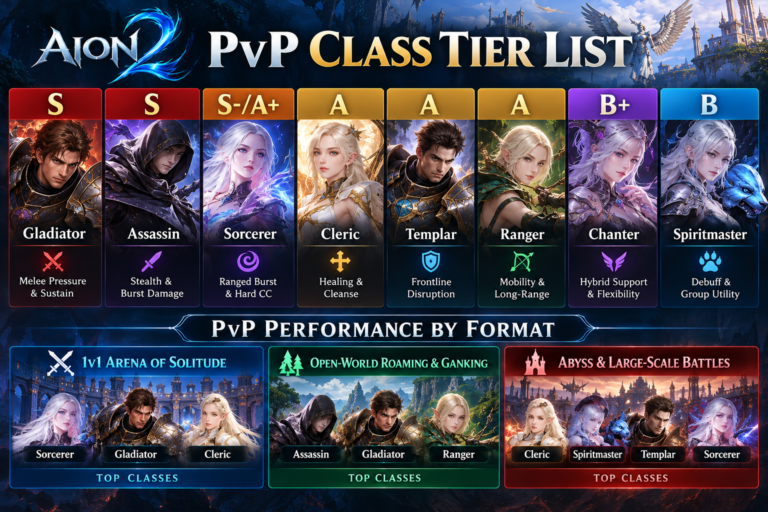
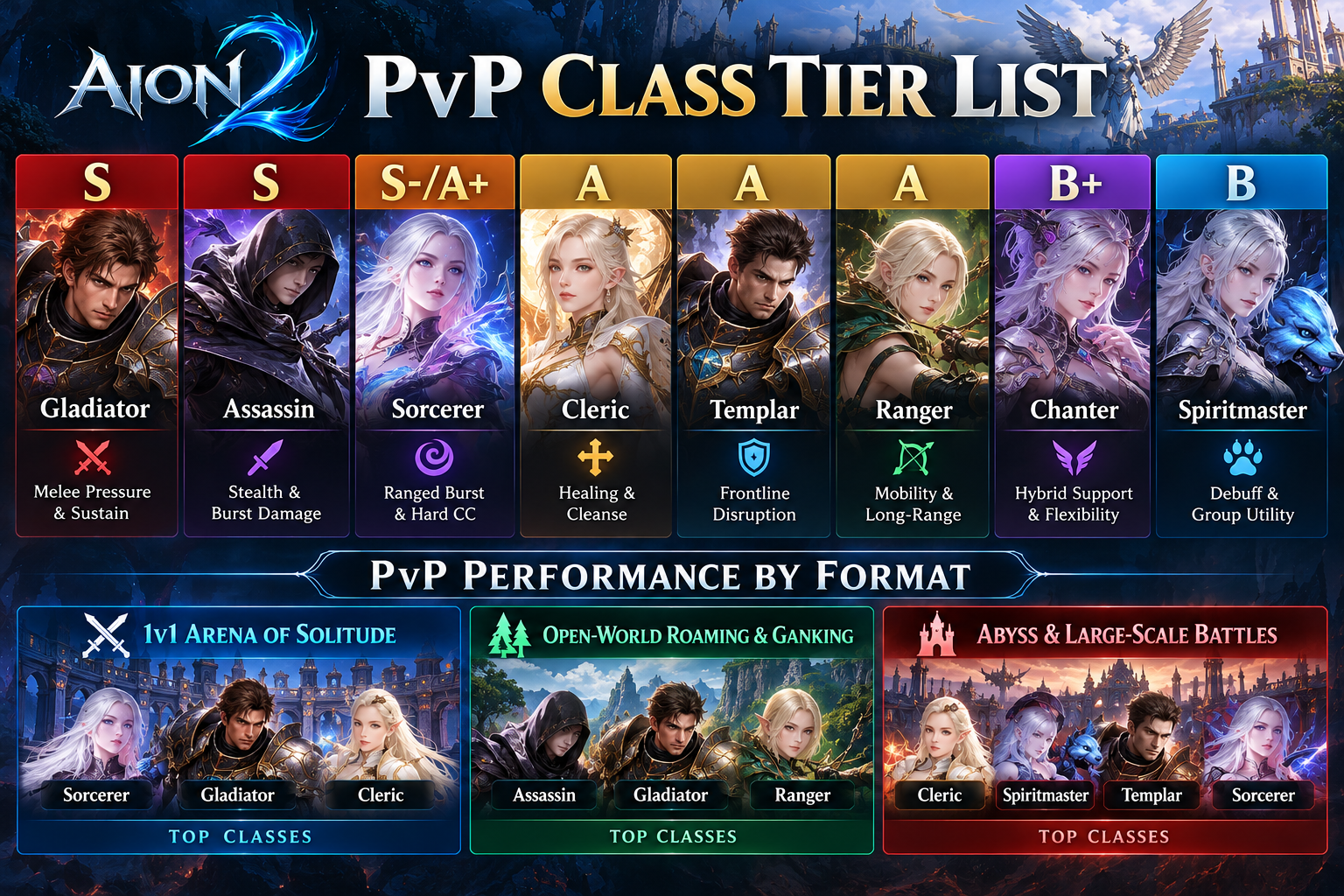
In Aion 2, PvP strength heavily depends on the format: 1v1 Arena of Solitude, Solo/Duo Open-World Roaming, and Large-Scale Abyss/Group Battles.
Overall PvP Tier List Breakdown
| Tier | Class | Primary Strength | Weakness / Limitation |
|---|---|---|---|
|
S |
Gladiator |
Relentless melee pressure, high knockdown CC, active block, and sustain. Dominates open world and duels. |
Vulnerable to focused ranged burst in mass open-field skirmishes. |
|
S |
Assassin |
Top-tier stealth initiation, lethal burst damage, and cooldown disruption. |
Highly fragile once unstealthed; struggles in clumped 5v5/Abyss frontlines. |
|
S- / A+ |
Sorcerer |
Devastating ranged burst and layered hard CC (Polymorph, aerial locks, roots). |
Squishy target; requires strong positioning and peels against divers. |
|
A |
Cleric |
Match-deciding healing, cleanses, anti-heal debuffs, and defensive sustain. |
Limited solo kill pressure; prime focus target for enemy burst DPS. |
|
A |
Templar |
Unmatched survivability, frontline disruption, and pulls to isolate backlines. |
Low burst damage; easily kited in 1v1s by mobile ranged classes. |
|
A |
Ranger |
High mobility, long-range poke, stealth, and trap utility for kiting. |
High latency dependence; squishy when gap-closers penetrate range. |
|
B+ |
Chanter |
Excellent hybrid bruiser/support, party buffs, and strong roaming flexibility. |
Jack of all trades; out-damaged by pure DPS and out-healed by Clerics. |
|
B |
Spiritmaster |
Unrivaled debuffing and coordinated disruption in organized group play. |
Pets are easily counter-played in fast duels; weak when ambushed unexpectedly. |
PvP Performance by Format
1. 1v1 Arena of Solitude
Top Classes: Sorcerer, Gladiator, and Cleric
Sorcerer, Gladiator, and Cleric top the ranks. Sorcerer easily controls spacing with instant-cast CC chains, while Gladiator and Cleric simply out-sustain and out-trade opponents in restricted spaces.
2. Open-World Roaming & Ganking
Top Classes: Assassin, Gladiator, and Ranger
Assassin, Gladiator, and Ranger excel. Stealth classes dictate when and where fights start, giving them a massive edge when picking off solo targets.
3. Abyss & Large-Scale Group Battles
Top Classes: Cleric, Spiritmaster, Templar, and Sorcerer
Cleric, Spiritmaster, Templar, and Sorcerer take over. Frontline peels, area crowd control, and sustained team healing matter far more than single-target burst when fighting over objectives.
Which Class Is Currently Ranked S-Tier for 1v1 Arena PvP in Aion 2?
The consensus across official server leaderboards (NCSOFT data via Shugo.GG) and competitive duel rankings places Gladiator as the undisputed S-tier class for 1v1 Arena PvP (Arena of Solitude), closely accompanied by Assassin depending on playstyle.
S-Tier Breakdown
1. Gladiator (Rank #1 Pick)
Why It’s S-Tier:
Dominates server leaderboards (holding rank 1 on nearly half of all regional servers). It combines high base durability (plate armor), reliable gap closers, knockdown/stagger chains, and potent lifesteal sustain.
Unlike pure glass cannons, Gladiators do not fold under burst openers and can outlast opponents while applying continuous melee pressure.
Core Strength: High fault tolerance, innate damage mitigation, and sustained lockdown combos.
2. Assassin (High-Tier Contender / S-Tier in Solo Duel Meta)
Why It Contends for S-Tier:
Holds the highest burst potential in 1v1 formats thanks to stealth openers, shadow gap closers, and the Elusive Clone burst window.
In skilled hands, it can delete opponents before defensive reactions are possible.
Limitation: Punishingly low margin of error; failing an opener or getting caught out of stealth drops it rapidly compared to the consistent resilience of a Gladiator.
Quick 1v1 Duel Hierarchy
| Tier | Classes | Playstyle & Matchup Notes |
|---|---|---|
|
S |
Gladiator, Assassin |
Top kill pressure, dominant opener/sustain kits, leading leaderboard representation. |
|
A |
Spiritmaster, Sorcerer |
High crowd-control (fears, silences, sleeps) and burst, but punished if caught without defensive cooldowns. |
|
B |
Ranger, Templar |
Rangers struggle once gap-closed in small duel arenas; Templars have unmatched survivability but lack burst kill-speed. |
|
C |
Chanter, Cleric |
Dominant in 5v5 and mass Abyss skirmishes, but their kits lack sufficient solo kill threat against sustained DPS in 1v1. |
How Does the Gladiator Class Maintain Its High Win Rate and Dominance in Melee PvP?
The Gladiator maintains top-tier win rates and near-universal S-Tier status across both 1v1 duels and group melee combat in Aion 2. Its dominance stems from a kit designed to win wars of attrition through persistent crowd control, defensive stat scaling, and reliable gap closing.
1. Oppressive Knockdown & Aerial CC Chains
Gladiators dictate fight tempo by keeping opponents grounded or incapacitated:
– High Knockdown Proximity: Openers like Mocking Blade and Rush Strike feature high base knockdown rates and specialty upgrades that bypass enemy Block and Evasion stats.
– Control Extension: Skills such as Aerial Snare inflict Forced Fall and prolong CC windows, preventing targets from retaliating or recovering their defensive resource gauge.
– Passive Control Amplification: Passives like Impact Hit boost the trigger probability of stagger and aerial setups, ensuring consistent CC uptime even against targets stacking basic resistances.
2. High-Forgiveness Defensive Passives
Unlike pure assassins or glass-cannon melee DPS, the Gladiator can trade blows recklessly due to passive survivability tools:
– Survival Willpower: Cuts status effect duration (stun, knockdown, freeze) by up to 60%, effectively breaking opposing chain-CC combos without always having to blow manual breakaways.
– Blood Absorption: A passive safety net that triggers sub-50% HP to restore up to 39% max HP per minute, alongside basic attacks that heal on contact (~3% HP per hit).
– Tenacious Stigmas: Emergency stigmas (such as Tenaciousness) grant brief invulnerability windows upon taking hard CC, doubling incoming healing and restoring health upon expiry to completely counter lethal burst setups.
3. Sticky Gap-Closing & Mobility
Kiting is traditionally the primary counter to heavy plate fighters, but the Aion 2 Gladiator kit provides continuous re-engagement:
– Ruinous Blow & Leaping Slam: Low-commitment gap closers that rush straight into melee range, instantly activating the Prepare for Battle buff and granting high burst initiation.
– Lunge Stance: Grants flat combat and move speed scaling, giving Gladiators the raw baseline speed needed to stick to nimble targets like Rangers and Sorcerers once gaps are bridged.
4. Overwhelming Attrition Damage
Rather than relying entirely on a single cooldown burst window, the Gladiator’s damage engine excels in sustained trades:
– Overhead Slam & Rending Blow: Serve as consistent, low-downtime damage dealers with built-in crit and resource engines that maintain pressure regardless of fight length.
– Attack Preparation: Passively increases baseline PvP damage output, allowing the class to melt through squishier melee opponents while relying on natural plate armor to mitigate incoming trades.
Is the Assassin Class Top-Tier for PvP, or Does It Require Too Much Gear and Skill to Work?
In Aion 2, the Assassin is widely ranked S-tier for small-scale PvP and open-world roaming, but it is also the classic "high-investment, low-margin-for-error" class.
It is undeniably top-tier when mastered, but it absolutely demands dedicated gear optimization and precise execution to function effectively.
1. Where Assassin Sits in the PvP Meta
– 1v1 Duels & Open-World Ganking (S-Tier): Assassin dictates fight pacing via Stealth openers, back-attack amplification, and rapid crowd-control lockouts (stuns, silences, and blind effects). The burst window enabled by Elusive Clone and Insignia Explosion allows you to delete squishy backliners (Sorcerers, Clerics, Rangers) before they can react.
– Small Skirmishes (A+ Tier): In 2v2 or 3v3 skirmishes, an Assassin acts as the primary executioner by peeling or assassinating isolated high-threat targets.
– Large-Scale / Mass Faction Warfare (B to C Tier): Assassin falls off sharply in mass battles. Once exposed to cross-fire AoE, concentrated crowd control, and coordinated group peeling, its fragility makes frontline engagements very unforgiving.
2. The Skill Floor vs. Skill Ceiling
– Positional Execution: Much of your burst damage relies on back-attack multipliers (Rear Smite, Ambush). Misjudging an approach or hitting shields from the front cuts damage significantly.
– Network & Ping Sensitivity: Assassin relies on rapid animation cancels, weave-stepping, and split-second CC chains. High or unstable ping severely degrades your burst throughput and evasive dodges.
– No Room for Recovery: Unlike Gladiators or Templars, who possess built-in sustain and plate damage mitigation, an Assassin that fails its opener or gets CC-locked without a breaker (Defiance) usually dies within seconds.
3. Gear & Stat Dependencies
The class suffers more from "gear stat checks" than most other archetypes:
| Stat / Equipment Focus | Why It Matters |
|---|---|
|
Critical Hit & Crit Damage |
The burst chain (Hardcore, Insignia) is heavily gated behind landing crits to proc reset windows and high multipliers. Low crit leaves targets surviving the opener with 20–30% HP. |
|
PvP Attack / Penetration |
Needed to pierce through Plate/Shield defenses (Templar/Gladiator) and break high-tier Cleric shielding. |
|
Combat Speed & Move Speed |
Dictates gap-closing efficiency and how tightly you can sequence combos during a target’s stun duration. |
|
Evasion & CC Break Roles |
Serves as your primary defensive buffer against incoming burst when stealth breaks. |
4. The Verdict
– Top-tier? Yes, specifically for duels, roaming, and pick-based PvP.
– Does it require too much gear and skill? Yes. If you are undergeared, you will run out of damage mid-combo and get killed on the counter-attack.
If you prefer a more forgiving, high-impact PvP class that functions well right out of the box with baseline gear, Gladiator or Ranger offers a much smoother floor while remaining highly competitive in both solo and group battles.
Why Are Chanter Hybrid Supports Performing So Strongly in Early Global Patch Metas?
Chanters dominate early global patch metas in Aion 2 primarily because early progression environments reward role compression. By combining party-wide damage multipliers, front-loaded stagger/crowd control, and sufficient burst healing to replace or supplement pure healers, Chanters dramatically accelerate dungeon clear times while teams are undergeared.
1. Aura Scaling Outvalues Marginal Pure DPS
In early-tier patches where player stats (critical rate, accuracy, and penetration) have not reached endgame saturation, flat percentage party buffs offer greater returns than a fourth dedicated DPS slot:
– Undefeated Mantra: Provides permanent party-wide PvE damage boost and damage reduction (mitigation). Multiplying the damage of top-tier burst classes (like Sorcerers and Rangers) yields higher group DPS than slotting another unoptimized damage dealer.
– Stat Deficit Patching: Early gear checks often cause missed hits or lower ability uptime; Chanter mantras and passive combat speed/accuracy enhancements smooth out these thresholds across the entire squad.
2. "Cleric-Lite" Role Compression in Farm Content
Except for the highest-tier raid mechanics requiring dedicated Cleric burst-healing, most early leveling and farming dungeons do not deal enough continuous damage to justify a zero-damage pure support:
– Recuperation Specialization: Skill specializations (such as the double-cast upgrade) allow Chanters to handle group damage spikes and debuff cleanses on demand.
– Sustained Leech: Skills like Healing Touch grant party-wide health returns on basic attacks, keeping melee frontlines topped off passively while maintaining offensive pressure.
– Faster Dungeon Cycles: Swapping a dedicated Cleric for a hybrid Chanter eliminates the single largest group DPS penalty in sub-cap and early endgame content.
3. Deceptively High Personal Burst Rotations
Unlike traditional MMO buffbots, Chanters in Aion 2 deal competitive melee damage due to tightly looped skill specializations:
– Dark Crush Chaining: The core offensive loop (Spinning Strike or Impactful Crush into Dark Crush) allows Chanters to weave guaranteed crits and minimal-cooldown strikes into their basic attacks.
– No Downtime: Abilities like Onslaught return MP on hit while resetting offensive cooldowns, bypassing early mana-management bottlenecks that plague other caster classes.
4. Boss Stagger and Crowd Control Control
Progression bosses feature strict break/stagger thresholds where boss mechanics must be interrupted:
– Chanters bring heavy stagger-gauge depletion on short cooldowns via staff skills (e.g., Rushing Smash, Wind’s Promise, and stun/knockdown chains).
– In open-world PvP (Abyss and rift skirmishes), this same toolset—gap-closing stuns into guaranteed knockdowns—makes them difficult to pin down and lethal when peeling for squishy backliners.
Which Healing and Support Class Is Better for Group and Abyss PvP: Cleric or Chanter?
Cleric is the better primary healer, while Chanter is the superior offensive buffer and force multiplier. Neither class replaces the other, but their value changes depending on your party composition and combat scale in Abyss PvP.
1. Comparison for Group & Abyss PvP
| Feature | Cleric | Chanter |
|---|---|---|
|
Primary Role |
Main healer, debuffer, team reset |
Offensive support, aura buffer, off-DPS |
|
Healing Output |
High & Burst (AoE heals, emergency shields, cleanse) |
Moderate/Sustained (HoTs, small bursts, support shields) |
|
Kill Pressure |
Very low personal damage; relies on CC/roots/debuffs |
High hybrid pressure; melee CC/knockdowns and burst assist |
|
Mobility & Positioning |
Backline caster; vulnerable to dive if caught out |
Frontline/midline skirmisher; high mobility and active defense |
|
Flight / Abyss Value |
Vital for surviving enemy dive trains and AoE carpet bombing |
Movement speed/stat mantas critical for chasing down targets |
2. Cleric: The Essential Foundation
– Non-Negotiable Group Survival: A group without a Cleric in small-scale or large-scale Abyss skirmishes collapses under focused burst from Assassins and Sorcerers.
– Dispel and Cleanse Dominance: Fast targeted and AoE dispels neutralize silence, stuns, and crowd control chains, keeping frontliners functioning.
– Target Priority: You will almost always be the primary target for enemy focus in Abyss skies, requiring strict defensive positioning and survival management.
3. Chanter: The Force Multiplier
– Offensive Group Amplification: Group-wide stat boosts, damage increases, and movement speed buffs let your melee/ranged DPS secure kills during burst windows.
– Disruption and Peel: Equipping staves allows Chanters to apply frontline stumbles and knockdowns, peeling for squishy allies or locking down retreating targets in three-dimensional aerial fights.
– Secondary Sustain: Excellent at maintaining sustained regen, but struggles to counter coordinated spike damage alone.
4. Which Should You Pick?
– Pick Cleric if your primary goal is pure support, keeping allies alive under heavy focus, and serving as the defensive backbone of organized PvP squads.
– Pick Chanter if you prefer a high-tempo, hybrid playstyle that blends aggressive brawling, CC setups, team speed, and offensive buffs with emergency backup healing.
In top-tier group PvP setups, running both is the gold standard: the Cleric handles the damage intake while the Chanter accelerates kill pace and mobility.
How Do High-Level Stigma Skills and Item Score Requirements Shift a Class Up or Down the Tier List?
In Aion 2, class tier lists look radically different at the early leveling stage compared to the endgame. The shift is governed by two interlocking bottlenecks: Stigma level breakpoints (which overhaul base kit cooldowns, status conditions, and multi-hits) and Gear Score / Item Level requirements (which dictate entry into high-tier instances and enforce strict stat thresholds like Accuracy and Crit caps).
1. How High-Level Stigmas Reshuffle the Tier List
In Aion 2, base skills provide raw numbers, but Stigmas upgraded via Stigma Shards unlock transformation perks that alter action economy and skill chains.
Classes That Skyrocket (C/B Tier → S Tier)
Assassin
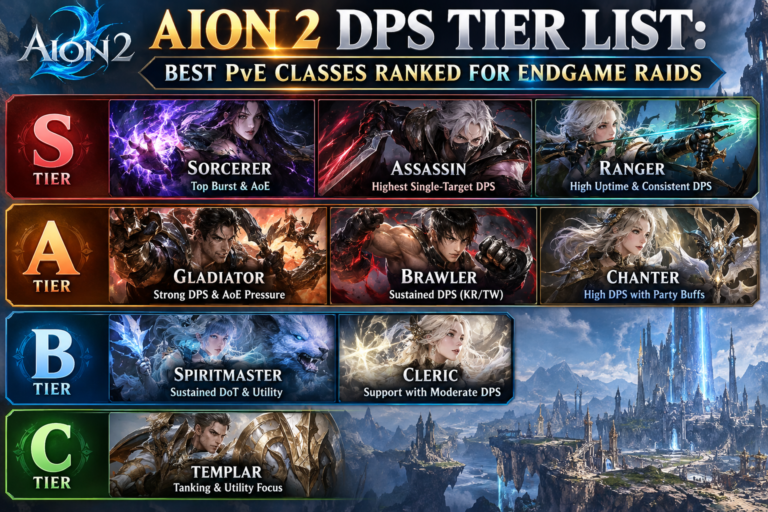
At low investment, Assassins struggle in PvE due to positional requirements and downtime. Once they max core Stigmas like Vaizel’s Authority (unlocking CDR on critical hits) and burst augmentations, their APM and burst cycles multiply exponentially, catapulting them to top-tier single-target DPS and premier PvP ambushers.
Chanter
Moves from an early-game "passive buffer" to an indispensable hybrid powerhouse. High-investment Stigmas such as Power of the Storm provide massive group-wide cooldown reductions and personal speed buffs that anchor raid compositions.
Spiritmaster
Early summon AI and static DoT pacing feel clunky. Investing heavily into Summon: Ancient Spirit and specialized debuff Stigmas enables massive party amplification and persistent burst windows, moving them toward top-bracket utility/DPS.
Classes That Plateau or Slip Relative to the Meta
Gladiator
Dominant during the early-to-mid leveling curve due to inherent AoE damage and durability. However, their Stigma enhancements (such as Zikel’s Blessing on long 120s cooldowns) scale more linearly rather than fundamentally breaking cooldown loops, causing them to fall behind hyper-scaling burst classes in high-end PvE DPS checks.
Sorcerer
While hard-hitting with baseline elemental nukes, their late-game Stigmas emphasize setup-heavy ground AoEs (Fire Wall, Cold Storm) and delayed marks. In highly mobile boss encounters, missing these damage windows penalizes them harder than classes with instant or target-locked scaling.
2. How Item Score (Gear Score) Gates Shift Viability
Endgame progression in Aion 2 ties dungeon entry, hit consistency, and mitigation to item score thresholds (driven by gear enhancement, Daevanion boards, and accessory morphing).
Stat Ceiling Dependencies (Accuracy, Crit, and Defense Scaling)
Assassin & Ranger (Gear-Sensitive)
High-tier bosses possess elevated evasion, block, and resistance stats. If an Assassin or Ranger is slightly below the recommended gear score, missed hits disrupt combo chains (e.g., Insignia stacking). Once they surpass the stat soft-caps with upgraded gear, their damage scales exponentially.
Templar & Defensive Tanks
As dungeon requirements jump, under-geared tanks get crushed by unmitigated tank-busters. However, once a Templar meets high gear thresholds and stacks Stigmas like Battlefield Banner (which converts bonus Defense into raw Attack), they shift from a slow, niche meatshield into an efficient bruiser capable of high aggro retention and solid DPS.
"Budget-Friendly" vs. "High-Investment" Curve
Low-Investment Floor (Cleric / Chanter / Ranger)
Can comfortably clear content at minimum gear thresholds because party utility, heals, and ranged positioning compensate for lower personal gear scores.
High-Investment Floor (Assassin / Gladiator)
Melee DPS classes hovering near minimum item level struggle with survival in melee cleave mechanics and underperform on DPS meters, making them widely avoided in high-tier PUGs until heavily geared.
3. Summary Matrix
| Class | Early / Baseline Tier | End-Game Tier (Max Stigmas + High Gear Score) | Key Scaling Driver |
|---|---|---|---|
|
Assassin |
B-Tier |
S-Tier |
CDR on crit Stigma + Accuracy/Crit stat caps |
|
Chanter |
A-Tier |
S-Tier |
Group cooldown reduction Stigmas + hybrid damage scaling |
|
Ranger |
A-Tier |
S-Tier |
High uptime, ranged boss positioning, multi-hit buffs |
|
Spiritmaster |
B-Tier |
A/S-Tier |
Ancient Spirit scaling + stacking group vulnerability debuffs |
|
Templar |
B-Tier |
A-Tier |
Survivability against raid tank-busters + Defense-to-Attack conversion |
|
Gladiator |
A-Tier |
B-Tier |
Linear scaling and long Stigma cooldowns relative to boss burst windows |
|
Sorcerer |
A-Tier |
B/A-Tier |
Positional/static casting penalties on high-mobility raid encounters |
Which Ranged Damage Dealer—Sorcerer, Ranger, or Spiritmaster—Dominates Ranged PvP Combat?
In Aion 2, dominance among ranged damage dealers depends heavily on the scale of combat. While Spiritmaster holds the crown for the most oppressive 1v1 and skirmish control, Sorcerer dominates large-scale teamfights with sheer burst, and Ranger excels at roaming pick-offs and high-mobility kiting.
1. Head-to-Head Comparison
| Category | Sorcerer | Ranger | Spiritmaster |
|---|---|---|---|
|
Damage Profile |
High AoE & single-target magic burst |
Sustained physical burst & rapid finishers |
Attrition, DoTs, and summon pressure |
|
Crowd Control (CC) |
Hard stops (Curse Tree, Sleep, Stun) |
Traps, binds, snares, silences |
Unmatched hard CC (Fear chains, Seals) |
|
Mobility & Range |
Low mobility, relies on teleport/spacing |
Very high mobility & stealth openings |
Moderate; kites while pets apply pressure |
|
Utility |
Area zoning, shield mitigation |
Stealth detection, vision, anti-kite |
Mass buff removal (Seize Magic), anti-heal |
|
1v1 Roaming |
Good (punishing if caught) |
Excellent (burst from stealth) |
Dominant (strips buffs, resets fights) |
|
Group / Abyss War |
Dominant (massive AoE wipe potential) |
Great (priority target execution) |
Top-tier disruption (peels & purges) |
2. Class Breakdown
2.1 Spiritmaster: The Attrition & Control Tyrant
Why It Dominates:
In duels and small skirmishes, the Spiritmaster is the most hated ranged adversary. Skills like Seize Magic strip enemy defensive buffs, shields, and stances, while Soul’s Cry (Fear) forces long fight resets that bypass traditional defenses.
Defensive Layer:
With damage-sharing mechanics like Command: Proxy, Spiritmasters split incoming burst with their summons, making them surprisingly tanky compared to traditional robes.
Weakness:
Lower upfront burst speed; relies on sustained attrition and pet uptime rather than instant kills.
2.2 Sorcerer: The Nuclear Teamfight Finisher
Why It Dominates:
If left unpressured in mid-to-large group fights (Abyss sieges and rift clashes), Sorcerer puts out the highest burst damage in the game. Setting up a crowd with Curse Tree or sleep and unleashing top-tier burst rotations can wipe clustered enemies before healers react.
Defensive Layer:
Limited to defensive barriers and instant blinks.
Weakness:
Long cast animations leave them vulnerable to interrupts, stuns, and stealth openers. If caught out of position, they crumble quickly.
2.3 Ranger: The Mobile Assassin of the Ranged Tier
Why It Dominates:
Ranger provides high-impact physical burst without being anchored down by long stationary castbars. Using stealth and high base movement speed, Rangers choose when to engage, locking down targets with silences, snares, and burst chains.
Defensive Layer:
Evasion buffs, traps, and stealth resets.
Weakness:
Struggles against heavily armored targets (Templars/Gladiators) and lacks the fight-altering AoE impact of Sorcerer or the pure dispel utility of Spiritmaster.
3. The Verdict
– For 1v1, Duels, and Small Skirmishes: Spiritmaster takes the top spot. Its ability to strip buffs and lock opponents into fear chains gives it favorable matchups across almost all classes.
– For Large-Scale Faction & Siege Battles: Sorcerer dominates with unmatched area-of-effect burst and lethal choke-point zoning.
– For Solo Roaming & Open-World Picks: Ranger provides the best mix of stealth, target isolation, and escape potential.
What Makes the Templar an Essential S-Tier Pick for Abyss Sieges and Objective Control?
In Aion 2, the Templar is considered an essential S-tier pick for Abyss Artifact Sieges and objective control because large-scale faction warfare is decided by space control, frontline stability, and protecting high-value targets.
While burst classes secure kills, the Templar dictates where and how engagements happen around capture points.
1. Hard Choke Control and Mass Displacement
Abyss Sieges revolve around cramped capture perimeters, gate chokes, and Artifact platforms. The Templar excels at breaking enemy formations:
– AoE Displacement (Defiance / Hooks): Templar pull mechanics drag up to 4 targets from 20 meters away and root them in place. Pulling an overextended enemy healer or prime DPS directly into an allied firing line instantly creates number advantages before a point capture.
– Disruptive Crowd Control: Chained stuns and knockdowns (via Shield Rush and Pummel) punish enemies contesting Artifact radii, preventing them from channeling siege mechanics or casting sustained AoE.
2. Frontline Anchoring and Area Denial
In open aerial and ground combat, an unanchored group quickly folds under enemy AoE dive compositions.
– The "Frontline Wall": Templars establish a physical buffer line, forcing opposing melee rushers (Gladiators, Assassins) to commit into unfavorable trades.
– High Stagger Gauge Pressure: Siege objectives and Artifact guardians feature stagger bars. Templars deal exceptional Stagger Gauge damage with their shield combos, forcing PvE guardian phases to break faster even while under PvP crossfire.
3. Dedicated Backline Peeling (Healer Preservation)
Abyss PvP operates on a battle of attrition—the first team whose Clerics run dry or die loses the objective.
– Anti-Dive Counterplay: Stealth Assassins and mobile flankers prioritize diving the backline. A Templar stationed on peel duty can intercept divers with instant-target CC, mitigating incoming dive pressure before squishies get erased.
– Defensive Auras and Shared Mitigation: Abilities like Warding Strike reduce incoming damage across nearby allies, elevating group survivability against coordinated siege bombardment.
4. Unmatched Cooldown-Driven Survivability
Contesting an Artifact often requires soaking full enemy faction rotations without dropping:
– Immunity & Breakouts: Built-in CC resistance and defensive stances (Armor of Balance, Nezekan’s Shield) prevent Templars from being locked down and melted during the opening seconds of an engagement.
– Block & Self-Recovery Synergy: With abilities like Noble Armor and block-triggered Fury passives, the Templar converts absorbed blows into counter-pressure, standing on capture points far longer than any other class.
How Much Did Recent Balance Updates and PvP Damage Nerfs Change the Overall Class Hierarchy?
The recent major PvP balance adjustments—headlined by an across-the-board ~30% global PvP damage reduction alongside cuts to base sustain/life leech—fundamentally restructured the Aion 2 combat pacing.
By significantly increasing the Time-to-Kill (TTK), the update largely ended the "instant burst" meta. In its place, sustained pressure, crowd control chains, defensive mitigation, and attrition have taken over.
1. The New PvP Hierarchy
| Tier | Classes | Key Meta Impact & Post-Patch Role |
|---|---|---|
|
S Tier |
Templar, Cleric, Gladiator |
Massive winners of the slower TTK. With burst damage cut, Templar shields and CC let them control large skirmishes almost uncontested. Cleric value surged because surviving the initial engagement makes healing and dispels decisive. Gladiator (with personal DPS buffs and lockdown) dominates extended brawls and arena leaderboards. |
|
A Tier |
Assassin, Chanter |
Assassin lost the ability to reliably one-shot opponents through defensive cooldowns, demanding far stricter combo execution, yet remains top-tier for Abyss solo-ganking and reset pressure. Chanter gained significant sleeper viability due to team-wide defensive/movement buffs and utility debuffs. |
|
B Tier |
Ranger, Sorcerer, Spiritmaster |
Most impacted by the global damage cuts. Sorcerer and Ranger can no longer melt frontliners before gap-closers arrive, leaving their fragile defenses exposed in prolonged trades. Spiritmaster still brings strong fear/root utility, but pet adjustments and longer skirmishes make them situational outside structured group play. |
2. Key Takeaways from the Shift
Frontline & Healer Dominance
High burst was previously the main counter to tanks and healers. With damage reduced across the board, frontline bruisers can shrug off initial volleys, close distances, and dictate extended team fights.
Positioning Over "One-Shot" Openers
Glass-cannon ranged DPS (Sorcerers and Rangers) have seen the steepest drop in solo viability. They now require peeling and front-to-back coordination rather than simply blowing up targets from max range.
Execution Ceiling Raised for Melee Assassins
Assassins can no longer brute-force kills through pure gear burst. Successful players must play around stealth resets, rear critical timing, and cooldown tracking rather than all-in opener trades.
Which Class Is the Best and Most Forgiving Choice for Beginners Starting Out in Competitive PvP?
The Gladiator is widely considered the best and most forgiving choice for beginners stepping into competitive PvP in Aion 2.
While classes like Assassin and Sorcerer boast lethal burst potential, their fragile health pools and heavy reliance on precise positioning or cast management make mistakes instantly fatal. The Gladiator strikes the ideal balance between offensive pressure and survivability.
1. Why Gladiator Is the Most Forgiving
– High Survivability & Resilience: Built as a durable front-line bruiser, the Gladiator has a naturally large health pool and strong passive mitigation. If you misjudge spacing, miss a combo, or get caught off guard, your defensive buffer gives you room to recover rather than dying in an opening burst.
– Straightforward Crowd Control (Knockdowns): The class revolves around reliable gap-closers and hard-hitting Knockdown chains. Knockdowns are easy to confirm and do not require the intricate stealth setups or buff-window management demanded by an Assassin.
– Built-in Utility & Sustain: Tools such as Blade Toss allow you to harass from range while debuffing enemy defense and incoming healing, giving you pressure even before fully closing the distance.
– Low Skill Floor, High Ceiling: In 1v1 duels, open-world roaming, and skirmishes, its kit lets you stick to high-priority targets without needing micro-frame timing.
2. Comparing Other Beginner-Friendly PvP Archetypes
| Class | Role | PvP Strengths | Why It May Be Less Ideal for Beginners |
|---|---|---|---|
|
Gladiator (Top Pick) |
Melee Bruiser |
Durable, reliable knockdowns, steady pressure. |
Susceptible to heavy kiting in large, open-field mass battles. |
|
Templar |
Pure Tank |
Extreme crowd control (pulls/shields), nearly impossible to burst. |
Lacks solo kill pressure; requires a coordinated team to capitalize on pulls. |
|
Ranger |
Mobile Ranged DPS |
Safe range, high kite potential, forgiving against melee mechanics. |
Vulnerable if caught without defensive cooldowns; demands kite discipline. |
|
Cleric |
Healer / Support |
Essential for group PvP, high self-sustain. |
Primary target for enemy focus fires; relies on team coordination to secure kills. |
3. Starter Tips for Gladiator PvP
1. Don’t Blow Gap-Closers Early: Wait for ranged opponents or casters to commit their primary defensive rolls or pushbacks before burning your main dash/leap abilities.
2. Chain CC After Defense Breaks: Apply your defense and healing debuffs (like Blade Toss) before committing to full knockdown burst rotations to maximize damage windows.
3. Manage Melee Exposure in Group Fights: While sturdy in 1v1s and small skirmishes, diving blindly into concentrated ranged fire in large-scale faction battles will melt your HP bar. Flank exposed targets or wait for frontline initiates.
About the Author